
AIDS: Closing in on a cure
Thursday, December 3, 2009, 3:04 pm 2 Comments | Post a Comment

HIV
It took a generation, but researchers now dare to speak of a cure for HIV, the virus that triggered the AIDS epidemic in the late 1970s.
A laboratory experiment with a special mouse gives them hope.
The experiment is described in a peer-reviewed journal the Public Library of Science published in January 2008.
Mice don’t usually get HIV infections. But the BLT (short for bone marrow/liver/thymus) mouse is different. It is specially bred and has human stem cells implanted. The cells infiltrate the BLT mouse’s organs and tissues, which allows the virus to take hold similarly to how it does in humans.
In the experiment, researchers gave BLT mice an HIV medicine called Truvada before they infected them with the virus. Truvada contains two drugs, Viread and Emtriva, that target the virus’ ability to get into the genetic information of a cell and hijack it. None of the mice on Truvada got sick.
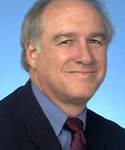
Dr. Myron Cohen
“If you can cure a mouse, you can potentially cure a human,” said Dr. Myron Cohen, head of the division of infectious diseases at the University of North Carolina at Chapel Hill and director of the UNC Center for Infectious Diseases.
Cohen (photo at left) spoke Tuesday at the headquarters of the foundation that manages North Carolina’s Research Triangle Park. His talk was part of a World AIDS Day event that celebrated 30 years of HIV/AIDS research.
Much of the work was done in the RTP area, long a hotbed of research in infectious diseases.
AZT, the first HIV/AIDS drug that became available in 1987, was discovered and developed here. So were Fuzeon, the first drug to prevent HIV from entering a cell, and Emtriva, a drug developed by Triangle Pharmaceuticals in Durham. Both came to market in 2003.
GlaxoSmithKline, in whose RTP labs AZT was discovered, has formed a partnership with Pfizer to come up with new HIV/AIDS drugs, but GSK continues to center its HIV/AIDS drug research and development at its U.S. headquarters in RTP. Gilead Sciences, which became the leading HIV/AIDS drug developer after buying Triangle Pharmaceuticals six years ago, still maintains Triangle’s operations in Durham.
Cohen called the RTP area one of the focal points in HIV/AIDS research worldwide. In U.S. funding for HIV/AIDS research it comes in second only to the San Francisco Bay area, he said.
The RTP area is home to RTI International and Family Health International, research institutes trying to stem the spread of HIV in developing countries. UNC and Duke University run HIV/AIDS clinics in Africa and, with more than 1,500 patients each, two of the largest U.S. HIV/AIDS clinics.
UNC and Duke are also part of the Center for HIV/AIDS Vaccine Immunology, orCHAVI, a research consortium of universities and medical schools worldwide. Directed by Dr. Barton Haynes, head of Duke’s human vaccine institute, CHAVI stands to receive up to $483 million from the National Institutes of Health to overcome roadblocks in HIV vaccine development.
Lymphocyte (green) infected with HIV (red)
HIV is a master shapeshifter.
Once it has hijacked its host’s immune system, the virus’ genetic code begins to change almost immediately. The rapid-fire mutations can quickly make the virus resistant to medication and require changes in a patient’s drug regimen.
The mutations have also foiled many attempts to come up with a vaccine.
In the past five years, two RTP area companies have shelved ambitious HIV vaccine development projects. Two years ago, U.S. drugmaker Merck halted the first test of an experimental HIV vaccine in humans because the vaccine seemed to increase the risk of an HIV infection rather than decrease it.
Researchers in Thailand have had more luck. A study that tested a vaccine on 16,000 drug addict volunteers was the first with successful results. Study participants who received a series of shots were 31 percent less likely to get infected with HIV than those who , according to study results that were reported in September.
(More on the Thai HIV/AIDS vaccine study later. The study will be a topic of discussion Dec. 17 at the Triangle Global Health Consortium breakfast meeting.)
But the immunity lasted only about a year - a modest improvement at best considering about 30 million people worldwide are HIV positive and for every person who receives treatment six get infected with HIV.


[...] More on Cohen’s talk, which he gave on World AIDS Day in Research Triangle Park, here. [...]
[...] RTP researchers have been at the forefront of developing breakthrough treatments since the early 1980s - from AZT, the first drug on the market, to current attempts of developing a vaccine. (More on the R&D efforts in RTP here.) [...]