Posts Tagged ‘Shodor’

“And now math is something you get.”
Tuesday, December 21, 2010, 11:08 pm No Comments | Post a Comment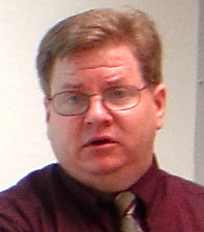
Bob Panoff
During a Bob Panoff show-and-tell it’s easy to forget the founder and executive director of the Shodor Education Foundation in Durham is talking about math, physics, science.
Among the things he likes to bring is a picture of waves on a cross. The trusted exhibit was along when Panoff spoke at this month’s Triangle Area Research Directors Council luncheon in Research Triangle Park.
The picture represents a trigonometric function on intersecting x and y axes and is a computational tool on Panoff’s laptop. He pulls up the formula that underlies the function and changes a multiplier. The waves get taller or shallower, but their frequency and length stay the same. Then he changes an addend. The waves come closer together or move farther apart, but their highs and lows don’t change.
“And now math is something you get,” Panoff told TARDC members. “Math and science are more about pattern and symbol recognition than numeric manipulation.”
At Shodor, Panoff and his staff of 15 use the same computational tool and others to help students understand that science doesn’t have to be a pain. It can be an onion, a problem that is solved one layer at a time, or a pearl, a solution built from an irritating grain of sand.
Students from fifth grade on can get the tools from Shodor’s Web site and learn chemistry, biology and physics through modeling or simulation. High school students can learn how to come up with the tools. Teachers and university faculty can learn how to use the tools as part of their lessons. And the more than 3 million page views per month on Shodor’s Web site suggest there’s demand.
What’s most important to Panoff is that the tools help students shift their attention from “What’s the answer to this problem?” to “How many different ways are there to look at the problem?” and “How do I know what’s right when I have multiple answers?”
Googling on the Internet is a surefire way to get multiple answers, Panoff said. The melting point of the radioactive chemical radium, for example, gets 116,000 hits on Google. Answers to the question include 1,292.0 degrees Fahrenheit, 1,392 degrees Fahrenheit and 1,291.7 degrees Fahrenheit.
And did you know numbers evoke feelings? Forty percent is less than half, but people in a shopping mall have a different perspective. To them 40 percent is a large number, Panoff said, because at a mall the number is associated with discount.
What Panoff is getting at is to get math and science is to understand that corrections of wrong answers will produce right answers, that verification and validation requires thinking skills and that handing out computers without training teachers on how to use computational tools isn’t preparing students to become part of the 21st century workforce.
View slides for Panoff’s TARDC presentation here.


