Posts Tagged ‘NCREN’

Expansion of fiberoptic superhighway to boost research, learning
Sunday, September 26, 2010, 2:47 pm No Comments | Post a CommentOver the next three years, Research Triangle Park-based MCNC will spent about $116 million to significantly expand the fiberoptic superhighway that most North Carolina researchers, teachers and public health officials use to generate, collect, crunch and store data.
The project will extend the N.C. Research and Education Network, which currently follows I-85 and I-40 from Charlotte to Raleigh, to rural areas along North Carolina’s border with Virginia, in the mountains and along the coast. The additional 2,500 miles of fiberoptic cable will provide enough bandwidth to boost remote learning possibilities for teachers and students on the Internet, allow researchers hobbled by limited bandwidth capacity to do more data-intensive projects and open up opportunities for statewide research collaborations.

Joe Freddoso
By 2013, when MCNC plans to be done laying the cable, North Carolina will have a fiberoptic infrastructure for research and education that will rival top-ranked networks in Massachusetts, New York, Michigan and Missouri, said Joe Freddoso, president and chief executive at MCNC.
“We will have an infrastructure that will carry us through the next couple of generations,” Freddoso said during a presentation he recently made to members of TARDC, the Triangle Area Research Directors Council.
The funds for the expansion are largely federal stimulus money, but MCNC and the Golden LEAF Foundation, which administers North Carolina’s tobacco settlement, also contributed.
Being able to generate, digest and analyze ever larger quantities of data is crucial and the growing appetite for computing power is turning the Triangle in an emerging hot spot for cloud computing.
N.C. State University, the University of North Carolina at Chapel Hill, SAS Institute in Cary and IBM in RTP are working on affordable ways to scale up the ability to store and crunch increasing amounts of data.
Interest in cloud computing, which taps existing computing capacity like utilities tap electricity from a grid according to demand, is particularly keen among researchers and organizations working in the public health arena.
MCNC’s fiberoptic network is used by all institutions in the UNC system, all 2,400 public schools statewide, two-thirds of the 36 independent colleges and universities, nearly half of all the institutions in the state’s community colleges system, research institutions and foundations, rural libraries, public health department and county health clinics. In a next step, MCNC wants to add all public hospitals in the state.
Also, remote or e-learning has taken off statewide. Enrollment has quadrupled since 2005 as more and more students make use of the computer as a classroom. Community colleges, for example, offer virtual classes in high schools that have no staff to teach the subject.
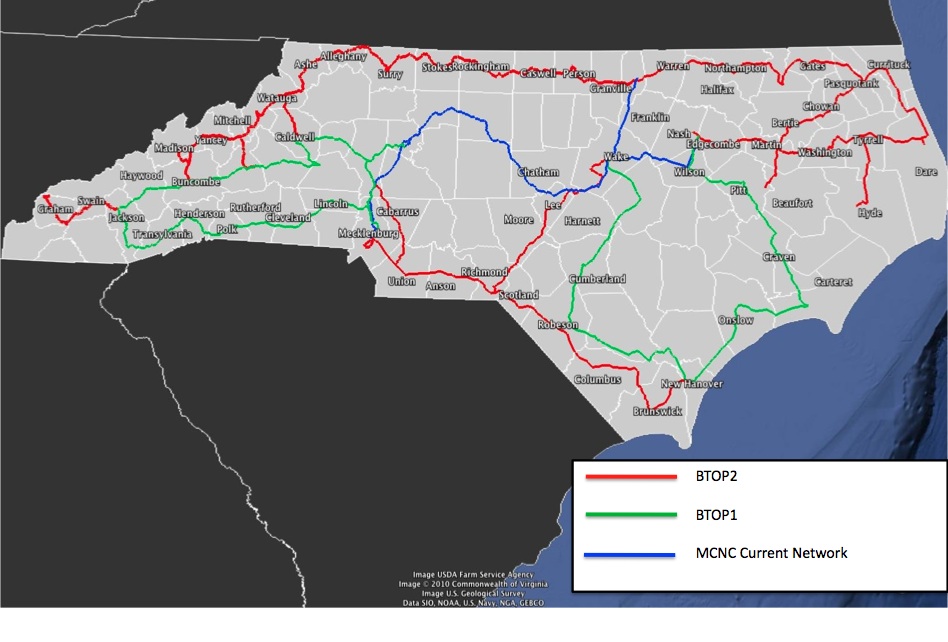
The expanded NCREN. Blue lines are existing network. Red and green lines are expansions.
Already, MCNC has 3 million users on the network per day.
Because of its limited capacity and geographical reach, MCNC’s existing fiberoptic network makes it difficult to accommodate all researchers in the state. Appalachian State University in Boone, Elizabeth City State University, UNC-Wilmington and UNC-Asheville are among the institutions that currently have to make do with a limited amount of bandwidth.
The network expansion over the next three years will also benefit the coastal studies institutes in Morehead City and on Roanoke Island and the National Climatic Data Center, the world’s largest archive of weather data, in Asheville.
MCNC plans to lay 48 strands of fiber along the proposed routes. That’s enough to add mobile connection points for researchers who, for example, work out in the field, take care of electronic medical records and lease bandwidth to commercial providers.


