Posts Tagged ‘NCCU’

Universities anchoring RTP step up economic development efforts
Monday, June 13, 2011, 10:41 pm No Comments | Post a Comment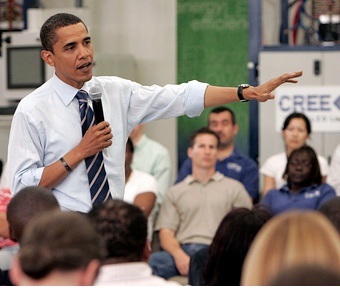
President Obama at Cree's manufacturing plant in Durham. Photo: Wall Street Journal
On his visit Monday to Cree’s Durham manufacturing plant President Obama brought his advisors from the Council on Jobs and Competitiveness along to impress on North Carolinians that his administration is focused on lowering the stubbornly high U.S. unemployment rate, which in May was 9.1 percent.
Jobs council members, which come from the business sector, labor and universities, are dedicating their time and energy to one singular task, Obama told Cree workers. “How do we create more jobs in America?”
Not far from where Obama was talking about getting out of the Great Recession, a job creation effort was under way to lower the state unemployment rate, which in April was 9.7 percent, and particularly the unemployment rate in the Research Triangle, which in April was at 7 percent in the Durham-Chapel Hill area and at 7.7 percent in the Raleigh-Cary area.
NCSU, Duke University and the University of North Carolina at Chapel Hill have long been engines of economic development in the region. They drove the formation of Research Triangle Park in the 1950s and educated the work force that attracted corporate research and development operations to RTP in the following three decades. The three universities that anchor RTP have also brought about technologies that started many an R&D company in the area.
Cree itself is a NCSU spinoff. The RTP company that makes light-emitting diodes, or LEDs, was formed in 1987 based on technology developed at NCSU.
With budget cuts for higher education looming, Triangle universities are stepping up and retooling their economic development efforts.
At NCSU, Terri Lomax, vice chancellor for research and innovation, is taking on responsibilities starting July 1 to help the state recruit companies and jobs, and the university is trying to boost the formation of spinoffs and their chances to survive and expand, be acquired or go public.
William Woodson, who was named NCSU chancellor in January 2010, established an innovation fund that will provide $2.5 million over the next five years to NCSU researchers to work on technologies that could be licensed or spun out as a company. To get off the ground, the young companies could tap into expertise at the university through a so-called proof-of-concept center on NCSU’s Centennial Campus.
To further accelerate startup formation, NCSU has joined forces with UNC, Duke, the Council for Entrepreneurial Development and N.C. Central University. The consortium is getting involved in the Blackstone Entrepreneurs Center, which has $3.6 million available over three years to evaluate technologies and tutor new companies.
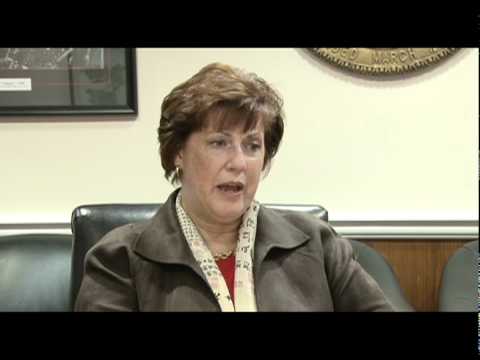
“Most new jobs come from companies less than five years old,” Lomax said in an interview with Science in the Triangle. “We want to do everything we can to help these companies be successful. Especially after a recession that’s extremely important.”
She suggested that the efforts could double the number of successful startups that NCSU spins out per year to 10 to 12 by 2015.
“What we want is sustained economic development,” Lomax said.
Watch the entire Science in the Triangle interview with Terri Lomax here:
NC history of flight extends to space
Thursday, May 19, 2011, 9:26 pm No Comments | Post a CommentNASA’s interest in North Carolina goes back to the 1960s, when U.S. astronauts came to the University of North Carolina at Chapel Hill to learn at the Morehead Planetarium how to navigate in space by looking at stars, according to a N.C. Museum of History report. In the past 25 years, a handful of North Carolinians flew on space shuttle missions, including Beaufort native Michael Smith, who died in 1986 when the Challenger exploded shortly after liftoff.
To prepare for and support NASA missions, researchers at N.C. State University have studied how to more precisely land a vessel on Mars and how to grow plants in a spacecraft operating in zero gravity.
But NASA’s involvement in North Carolina goes further. Since 1991, teachers and students at North Carolina universities, community colleges and public schools have received about $15 million to study science, technology, engineering and mathematics, to research issues related to space missions and to work in companies contracting with NASA.
Funding for the research grants, scholarships and summer internships has been provided through the N.C. space grant, a program administered at NCSU.
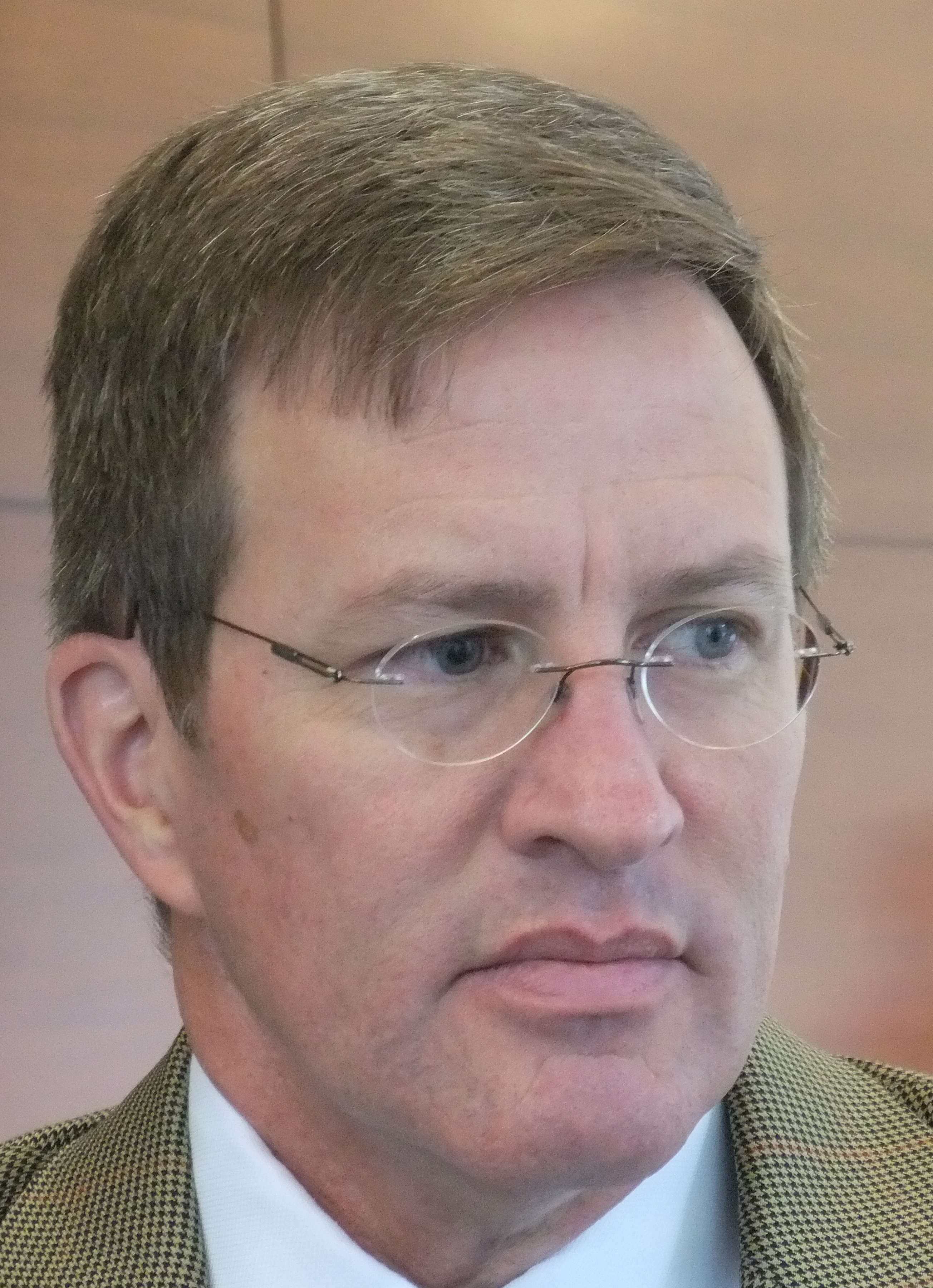
Christopher Brown
“The goal is to keep the pipeline filled for NASA,” Christopher Brown, director of the N.C. space grant, told members of the Triangle Area Research Directors Council who gathered this week at Research Triangle Park headquarters.
But “this isn’t just rockets and aerospace,” Brown said. Space grant projects in North Carolina include satellite tracking of red wolves and the development of an undergraduate robotics course at Duke University.
As a professor of plant biology at NCSU, Brown teaches a space biology class and some of his plant experiments will travel to the international space station on the last shuttle flight scheduled to take off in August.
NASA funds the N.C. space grant and similar programs in all other states through its annual budget.
In the past five years, the total for these grants has increased from about $30 million to $45.6 million. North Carolina’s portion is about $800,000 annually, Brown said. That includes a state match. The match used to be about $200,000 per year, but budget cuts have reduced it to $180,000.
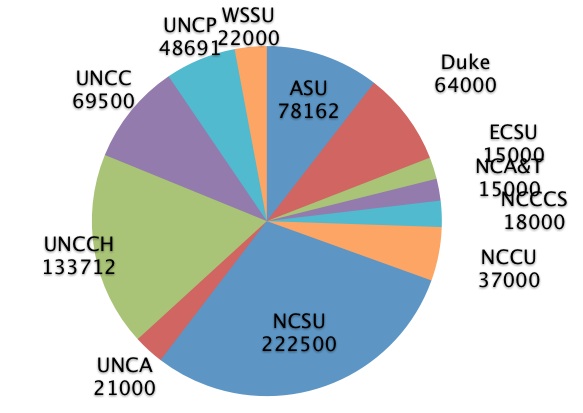
N.C. space grant beneficiaries
Federal cuts are also looming, but Brown said he didn’t think the program would be eliminated, because every Congressional district receives money. For fiscal year 2012, which starts Oct. 1, President Obama’s budget request for the space grant program is $26.5 million, according to NASA budget information. That’s a reduction of more than 40 percent.
In the past, N.C. space grant money has supported research of young university faculty, helped develop new college courses and paid for professional development of K-12 teachers, provided scholarships and summer internships for graduate and undergraduate students and students at community colleges.
Thirteen university campuses across North Carolina are affiliated with the N.C. space grant, from UNC Asheville to Elizabeth City State University.
Giving patients a voice could raise number of minorities, women in clinical studies
Monday, September 27, 2010, 10:28 am 1 Comment | Post a CommentAn oncoming heart attack tends to cause back pain and nausea in women and chest pain in men. Diuretics work better to treat hypertension in blacks than in whites. Asian Americans have higher cancer and tuberculosis rates than other ethnic groups and Latinos carry a higher risk to develop diabetes.
That one size doesn’t fit all in understanding and treating disease is a topic for casual conversation around water coolers in many places. In North Carolina’s Research Triangle Park area, it’s a reason to hold a conference.
Dozens of epidemiologists, nurses and community activists spent a whole day talking about health disparities and research to abolish them at N.C. Central University, where the second Clinical Research Education Day took place Saturday.
They talked about the Diabetes Improvement Project in Durham, for example. Launched in 2005, it’s an effort by Duke University, community organizations and churches to improve the health of African American diabetes patients. Diabetes is one of five conditions which disproportionally affect minorities; HIV/AIDS, cancer, cardiovascular diseases and obesity are the other four.
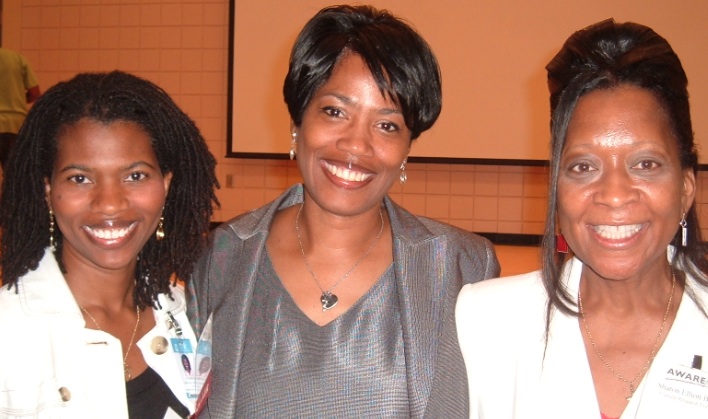
From left, Cheryl Woods Giscombe, Lori Carter Edwards and Sharon Elliott-Bynum.
They talked about the African American Collaborative Obesity Research Network, or AACORN, a Philadelphia-based initiative that has collaborators at several universities in the RTP area. And they talked about how research programs team up with community activists to overcome racism in biomedical research and to recruit more minority participants for studies.
“No more Tuskegee,” said Sharon Elliott-Bynum, a nurse and founder of CAARE, a community initiative that provides services to homeless veterans, substance abusers, HIV/AIDS patients and seniors. She was referring to the Tuskegee Syphilis Study, one of the worst examples of unethical biomedical research in the U.S.
“You can be an agent of change,” Elliott-Bynum added. “But you’ve got to be at the table.”
In an interview with Science in the Triangle, Elliott-Bynum, Lori Carter Edwards of Duke University and Cheryl Woods Giscombe of the University of North Carolina at Chapel Hill talked about how to improve research and get the study results to address health disparities. Listen to the audiotaped interview:
Audio clip: Adobe Flash Player (version 9 or above) is required to play this audio clip. Download the latest version here. You also need to have JavaScript enabled in your browser.
Q&A with Sandy Kennedy
Thursday, September 10, 2009, 7:39 pm 1 Comment | Post a CommentSandy Kennedy is an executive at Quintiles Transnational, where she is charged with making sure that studies testing new medicines follow federal and industry regulations and guidelines.
Pharma gets creative to find patients for tests
Thursday, September 3, 2009, 9:59 am No Comments | Post a CommentFree health screenings, food and a raffle promise to draw a crowd Sept. 12 at North Carolina Central University.
There’s a reason for all the goodies. Organizers want people to stay and listen — to speakers like Dr. Robert Califf, who heads Duke University’s Clinical Research Institute; Dr. Wendy Brewster, director of women’s health research at the University of North Carolina at Chapel Hill; and executives from Quintiles Transnational and PPD, two North Carolina companies that help drugmakers test new medicines.


