Posts Tagged ‘Jane Goodall’

Jane Goodall says “hello” to Duke University
Sunday, April 10, 2011, 8:14 pm No Comments | Post a CommentThe greeting was embracing but inquisitive. It emanated from deep within Jane Goodall and got louder, higher in pitch and more urgent with each bellow.

Jane Goodall
Goodall, the British primatologist considered the world’s foremost expert on chimpanzees, often starts her talks the way chimpanzees greet a new day in Gombe Stream National Park, the Tanzanian reserve where Goodall began her research in 1960 and where the institute she founded in 1977 still has a research project under way.
The greeting, Goodall has said, translates to, “Here I am. Who’s out there?”
Just six days short of her 77th birthday, Goodall stood on stage at the sold-out, 1,200-seat Page Auditorium at Duke University and again greeted her audience in Chimpanzeese.
But this time, she received in-kind answers from the audience. This welcome was special.
The March 28 Duke visit, Goodall’s third since 2007, followed two high-profile recruitments.
A year ago, Anne Pusey, a former field researcher for Goodall in Africa, joined Duke to head the evolutionary anthropology department. Pusey came from the University of Minnesota, home of the Jane Goodall Institute’s research archive since 1995. The archive is a daily expanding compilation of field notes, videos and photos and includes about 22 cabinets of paper files with many of the notes written by Goodall herself.
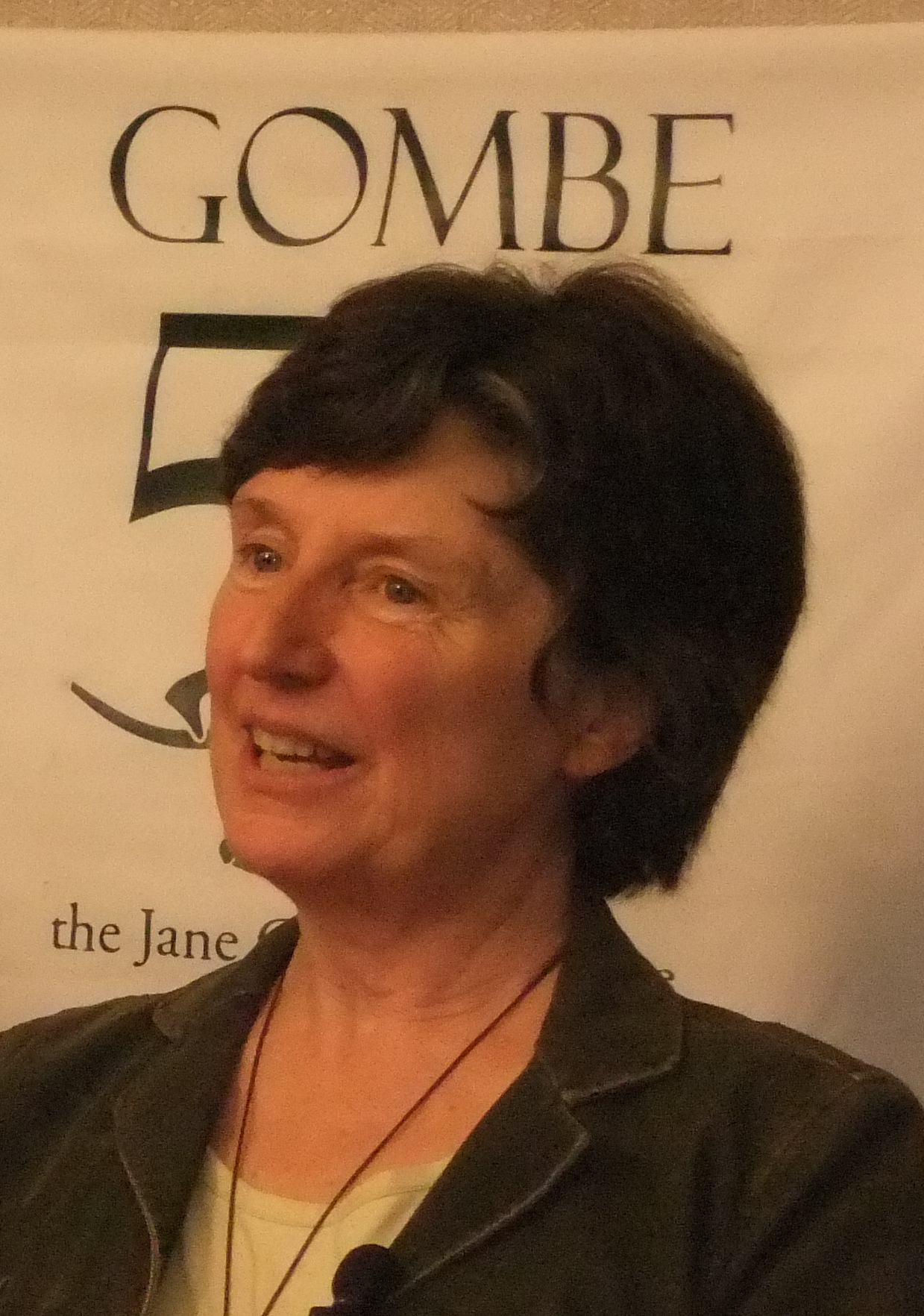
Anne Pusey
On March 17, Duke announced that the archive would follow Pusey to North Carolina and 11 days later, Goodall spent a very public day on the Duke campus, meeting journalists, visiting school children and talking about what she learned in the past 50 years.
In Minnesota, Pusey’s departure revived speculations that Goodall’s support for animal rights had ruffled feathers at the University of Minnesota, where researchers do extensive testing on animals, including on monkeys. Animal testing is also done at Duke, including invasive surgery testing on macaques. But joining Duke gained Pusey a distinguished, endowed professorship and a departmental chairmanship. At the University of Minnesota, she held the title of adjunct professor, usually a non-tenured, non-salaried position.
Also, Duke and the Jane Goodall Institute are exploring further collaborations, said Maureen Smith, the institute’s president. Environmental and humanitarian programs Goodall has started since the mid-1980s to preserve the chimpanzees’ rain forest habitat and improve the lives of neighboring villagers may offer research opportunities for Duke’s Nicholas School of the Evironment and Earth Sciences and the Duke Global Health Institute.
When asked at the press conference how she felt about the archive moving, Goodall answered, “I was happy for it to go where it needed to go.”
It was clear she didn’t want to talk about the archive’s 1,000-mile move. The woman, who showed a male-dominated academic world that humans aren’t the only ones using tools and that chimpanzees hunt prey and eat meat, preferred to talk about the encounters she’s had with “the animals that are most like us.”
Goodall’s favorites include stories about Fifi, Little Mama and Jojo.
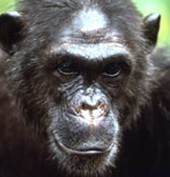
Fifi
Fifi was about 2 when Goodall started her Gombe field research in 1960. Monkeys and humans age similarly, as Duke primatologists have found. (More about that here.) And chimpanzees can get as old as humans. But Goodall said that none of the chimpanzees she met in the early 1960s - she called them “her old friends” - are alive anymore. Fifi, the last surviving old friend, died in 2004.
“She almost made it,” Goodall said.
Like her mother, Flo, Fifi was popular with the male chimpanzees and a very successful and caring mother. She gave birth to nine sons and daughters, according to the Jane Goodall Institute a Gombe record. Fifi attained a very high rank in the group and so did several of her sons.
Flo, Fifi and Fifi’s offspring helped Goodall learn a lesson that in retrospect she called one of the most interesting of her career.
“There’s good mothers and bad mothers in chimp society,” Goodall said. “The offspring who have good mothers do better.”
Whether there’s a special relationship between male chimpanzees and their offspring is one of the questions that the field data in the archive may answer, she said. “Who knows what we’re going to find analyzing 50 years of data.”
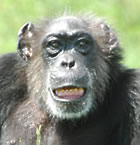
Little Mama
Little Mama is an example of how old chimpanzees can get. Born in 1938, the chimpanzee is just four years younger than Goodall and the oldest chimpanzee living in a zoo. The two have known each other for about 30 years and Goodall still visits Little Mama at the Lion Country Safari near West Palm Beach.
It’s usually easy to find Little Mama, Goodall said. She likes to wear a piece of cloth over her head.
To keep audience members from feeling like hugging the next best chimpanzee, Goodall also had a story about violent gang war between two groups of chimpanzees that used to be one. Males of one group didn’t rest until they had killed the males of the other group, she said, and compared the situation to the American Civil War.
Considering how dangerous male chimpanzees can be makes the story of Jojo particularly stunning. Goodall frequently ends her talks with this story and did so at Duke.
An essay Goodall wrote for Science in 1998 included this version of the Jojo story:
One of the unexpected rewards that I have found as I become increasingly involved in conservation and animal welfare issues, has been meeting so many dedicated, caring, and understanding people. I cannot close this without sharing a story that, for me, has a truly symbolic meaning. The hero in this story is a human being named Rick Swope who visits the Detroit zoo once a year with his family.
One day, as he watched the chimpanzees in their big new enclosure, a fight broke out between two adult males. Jojo, who had been at the zoo for years, was challenged by a younger and stronger newcomer, and Jojo lost. In his fear he fled into the moat which was brand new, and Jojo did not understand water. He had gotten over the barrier erected to prevent the chimpanzees from falling in—for they cannot swim—and the group of visitors and staff that happened to be there watched in horror as Jojo began to drown. He went under once, twice, three times. Rick Swope could bear it no longer. He jumped in to try to save the chimp, despite onlookers yelling at him about the danger. He managed to get Jojo’s dead weight over his shoulder, and then crossed the barrier and pushed Jojo onto the bank of the island.
Rick held him there—the bank was very steep and if he were to let go Jojo would slide back into the water—even when the other chimps charged toward him, screaming in excitement. Rick held Jojo until he raised his head, took a few staggering steps, and collapsed on more level ground.
The director of the institute called Rick. “That was a brave thing you did. You must have known how dangerous it was. What made you do it?”
“Well, I looked into his eyes. And it was like looking into the eyes of a man. And the message was, ‘Won’t anybody help me?’”
Another visitor at the Detroit Zoo caught the rescue on videotape. Here’s the TV news report with footage of the rescue:

Humans, monkeys age the same, say Duke primatologists
Sunday, March 27, 2011, 7:13 pm No Comments | Post a CommentOriginally published: 3/17/11
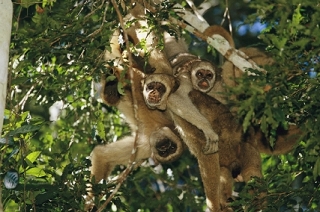
Studies find the muriqui monkey can live as long as the average human being
Humans share 98 percent of their DNA with monkeys. Clearly, the two species have a few things in common. One, say researchers from Duke University, is how we age.
Dr. Susan Alberts, a Duke biology professor, has been studying baboons in Kenya’s Amboseli National Park for quite some time. In fact, she’d just gotten off a flight home, she mentioned when interviewed.

Dr. Susan Alberts
Alberts is one of several Duke scientists who have teamed up with universities across the world to study aging behavior in wild primates. She said data was combined from seven different studies on non-human primates, each spanning 25 to 50 years. Two of these—the Jane Goodall Institute study on chimpanzees and Alberts’s Amboseli study on baboons—were based at Duke.
Findings from the studies appear in the March 11 edition of Science.
The studies chronicle primates over the course of their lives. Monkey populations were observed for births, deaths and physical deterioration. Alberts said long-term primate studies like these are invaluable to putting the human experience in perspective.
“Before, we didn’t have anything to compare to that was like us,” Alberts said. “So we were comparing ourselves to lab mice. And we are really different than lab mice.”
Dr. William Morris, a Duke ecology and population biology professor who assisted Alberts, said main conclusion of the report was that aging patterns and mortality risks coincide between humans and non-human primates.

Dr. William Morris
“Your chance of dying increases with age in a similar way whether you’re a gorilla or a baboon or a human,” said Morris. “Humans still win, but we’re not too far away from our primate relatives.”
According to the report, female chimpanzees often live into their forties, some even into their fifties. Males live into their thirties but are mostly dead by their early forties. Morris said the monkey with the longest life expectancy was not the chimp or gorilla, but rather the lesser-known Brazilian muriqui, which can survive all the way into its seventies.
That is not too far off from the average life expectancy of a human, said Dr. Anne Pusey, chair of Duke’s evolutionary anthropology department. Nowadays, the typical American male will live into his eighties. Females, she said, live slightly longer. The gender difference is more pronounced in monkeys, though, because of male-male competition for reproductive opportunities with a limited number of females.
Pusey has been working with renowned British primatologist Jane Goodall at her chimpanzee park in Tanzania since 1970. In the wealth of data she’s collected over four decades, she has developed an eye for identifying chimp aging behavior.

Dr. Anne Pusey
“Just knowing more about mortality patterns in other species helps us think about the evolution of our mortality patterns and understand which patterns are fixed and which are more elastic,” Pusey said. In the future, she and her colleagues plan to investigate how reproductive rates change with age.
“Humans are unusual in this regard because we hit menopause and continue to live a long time afterwards,” she said. “But female chimps go on having babies up until they die.”
Pusey took on her job at Duke last year. She said she was attracted to the area because she feels it’s one of the best of its kind in the country. Also, she had heard about Dr. Alberts’ study and discovered how much potential there is for primate research in the Triangle region.
Alberts said she’s interested in how animals use social behavior to solve environmental problems and how that impacts their survival. What characterizes the human race, she said, is that we’re primarily monogamous, which levels out competition among males.
This might seem counterintuitive at first. If females only mate with one male, wouldn’t there be increased drive for men to settle down with the most desirable female? Alberts said it is actually a great equalizer for the men, and everyone still ends up with a partner.
However, in non-human primate species, not everyone does. The females mate with multiple fathers, but not every male passes that litmus test.
“If females only mate with one male, it isn’t how many kids he’s going to have but how good a mate he’s going to get,” she said. “In primates, the least successful male wouldn’t have any kids at all.”
One finding that surprised her was that primate males are able to differentiate their own offspring. She found this remarkable since females mate with many different males in the course of a lifetime and there’s no discernable way for fathers to keep track of who’s whose. Paternal care goes very deep in our primate roots, she said.
“Human males are very good fathers, especially compared to most mammals,” said Alberts.
So in a lot of ways, socialization has factored into reproduction and life expectancy. Insight like this, Morris said, paves the way to understanding how human evolution has digressed from that our hairy ancestors.
“We live longer than the other primates because of the environment we create for ourselves,” he said. “Nutrition, modern medicine, health care—other primates don’t have these things.”
To Morris, the importance of the Amboseli study is in advocating long-term primate research because he thinks that’s how we really learn about the aging process. He said it’s much different than the plants he studies.
“With trees you can take a look at the core and see how old it is,” Morris said.
“You can’t do that with baboons and monkeys. You really need to follow them around to get the whole picture.”


