Posts Tagged ‘gaming’

Activate3D wants to make your virtual movement more real
Friday, January 21, 2011, 1:11 pm No Comments | Post a CommentThe lights in the conference room before him are dimly lit, but Dan Amerson is still scanning faces in the crowd as he paces excitedly, silhouetted by the glow of the projector screen behind him. He’s explaining to the audience, matter-of-factly, about the critical elements missing from the motion gaming industry today.
For more than three decades, video games offered players an effective method of digitizing their actions and translating them to on-screen motion. With dials, buttons and joysticks, gamers could manipulate their virtual worlds without much effort. It was tactile. Simple. And particularly with next-generation consoles, it granted the ability to make and break contact with objects in the game with a twist, mash or thrust.
But what took off with the Nintendo Wii in 2006 and continued this holiday season with the Xbox Kinect and Playstation Move was a desire for a more active form of interaction — motion.
That’s both a problem and an opportunity for programmers like Amerson, vice president of engineering for middleware developer Activate3D. As it turns out, computers are downright terrible at figuring out what you’re trying to do when you don’t have buttons.
But Amerson’s plan is to equip games to recognize that subtlety, using what his company calls intention recognition and synthesis.
“A lot of motion games out there can take your motion and they can put it on-screen, but what they can’t do is let you grab onto that object in the world and let you do something meaningful,” Amerson told the crowd at RTP Headquarters in Durham, N.C., Dec. 8.
If his company is successful in bringing its technology to market, Amerson believes it will change the way people engage virtual environments.
“The Playstation 3 and the Xbox 360 have not changed since they came out, yet everyone wants to have a bigger, better, badder game. So how do we do that? Well, we have to write better code, we have to make our artists smarter, give them better tools, come up with new tricks,” Amerson said.
HISTORY OF FAILURE

The Power Glove for NES. Photo courtesy of Matt Mechtley
Motion controlled games aren’t particularly new. Long before the Wii had consumers lining up outside stores in the cold, Mattel’s Power Glove for the Nintendo Entertainment System tracked course hand gestures in 1989. Despite grossing $88 million, it underwhelmed consumers.
Sega released its Activator peripheral in 1993, telling players in an elaborate four-minute instructional video how they were “pioneers on the interactive frontier.” The video also warned against placing the octagonal device, which worked when users broke an infrared beam, under overhead light sources or “metallic or mirrored ceilings.” It never caught on.
But as gaming systems became more powerful, peripherals manufacturers started getting the formula right. As a precursor to the more modern movement-based controllers, the Logitech EyeToy, released for the Sony PlayStation 2 before the holidays in 2003, attempted to capture motion by placing the player’s image on-screen using a camera. It sold 400,000 units in North America alone by the end of the year.
“People seem to have forgotten that there were games controlled solely by camera back on the PlayStation 2,” Amerson said. “As the technology moves forward, we’re going to get increasingly more accurate, better fidelity, interesting new combinations of the technology. We’ve now got the ability to use not just course motion, but actually some very precise motion.”
And that’s where devices like the Move and Kinect can succeed where others have failed, according to Michael Young, an associate professor of computer science at N.C. State who taught Amerson as an undergraduate (full disclosure: I’m employed by N.C. State as a journalism adviser).
“The real principle challenge is to correctly map a player’s intent to how they play the game,” Young, who teachers courses in video game design, said. “The greater the connection between the choices of the player and the feedback of the game, the greater the acceptance of the choices you have.”
But to cement that connection, Amerson says the Kinect and Move will need a little help from his company’s technology.
“Taking input data, taking someone cavorting in front of a camera and putting it on-screen is of limited interest. You’ll go do it sometime in your life and it’ll be fun. You’ll have a good time,” he said. “But 15 minutes later, you’ll realize that’s all there is to it.”
REDUCING THE NOISE
Booting up a small camera at the front of the dark Durham conference room, a miniaturized image of Amerson pops up in the corner of the screen behind him. Looming larger on the screen over the 6-foot-2-inch programmer’s shoulder is a teenaged avatar sporting a long-sleeved shirt and blue jeans, looking out over a vibrant playground.

Dan Amerson, from Activate3D, demonstrates his company's Intelligent Character Motion technology at RTP Headquarters Dec. 8. | Photo by Tyler Dukes
The kid on-screen mimics Amerson’s motions until he approaches a set of virtual monkey bars. Miming a leap without ever leaving the ground, Amerson closes his hands as his on-screen persona grasps the bars and hangs free, ignoring the real Amerson’s legs rooted firmly on the conference room floor.
Actions like these aren’t easy for a program to understand, especially given the limited data from one camera.
Take grabbing things, for instance. The image of an opening and closing human hand can appear radically different depending on how it’s positioned. And absent a controller, that image is all the program has to go on.
So Activate3D’s Intelligent Character Motion software helps it make an educated guess. By processing dozens of images of open and closed hands, the system builds a mathematical model. The team then pipes in live video of their hands while the system guesses if they’re open, and humans make corrections along the way.
The software also recognizes what the player intends to do — jumping for example — without literal action. This could help games overcome an obvious constraint: there are only so many fun things you can do from inside your house.
“If I’m in front of a camera in my living room and I start walking, I quickly run into a physical limitation of gameplay when I knock over the camera or run smack into my TV,” Amerson said.
Translating real-world motion into virtual action also runs the risk of falling into the “uncanny valley,” where unnatural movement of almost-lifelike 3D animation actually grosses us out. ICM avoids that gut reaction by augmenting the player’s motion and removing irrelevant input — like the position of Amerson’s legs when his avatar is hanging in mid-air. By filtering that signal, the program allows virtual gravity to take effect, letting the legs swing and the shoulders rotate naturally.
“I can break the rules of the virtual world very easily,” Amerson said. “We want to take all this into account and augment that — make you look like you’re doing what’s happening there — and then blend all that together, make it fit the environment, fit the physics and make it believable to you.”
By staying away from the uncanny valley, Young said players will get a more immersive experience when they step into the “magic circle” of a video game.
“The relationship between the body and avatar, by default, is one to one,” Young said. “When it doesn’t happen, it pulls us out of the game.”
Although Amerson said there will always be great games that map motion literally, augmentation opens new possibilities for moving gaming forward.
“Give me a Kung Fu game. I can mimic those motions, I could pretend that I’m Jackie Chan,” he said. “But wouldn’t it be really awesome if, in my living room, I can pretend to be Jackie Chan and on TV see my avatar move with the grace and the fluidity and the expertise of Jackie Chan or Jet Li?”
And he said helping players inhabit actions that aren’t their own is what motion gaming needs to move from amusing to memorable.
“The best games give you 80 percent of the experience with 10 percent of the effort,” he said. “I think ultimately, that’s what game designers are trying to do — giving you as big and as bold an experience as possible with a low barrier of entry so it stays fun.”
Tyler Dukes is a freelance science writer and full-time journalism adviser at North Carolina State University. Follow him on Twitter as @mtdukes.
Incentives spur gaming job growth in Texas; N.C. next?
Friday, January 7, 2011, 1:17 pm No Comments | Post a Comment
Gears of War 3, a highly anticipated title from Cary-based Epic Games, is set to hit stores in fall 2011.| Photo courtesy of Epic Games
If North Carolina’s newly enacted tax incentives for the video game industry are anything like those in Texas, they could give the area some much-needed job growth.
A new report from the Lone Star State attributes the addition of 1,700 jobs in the gaming industry over the last year-and-a-half in large part to tax incentives passed in 2007. North Carolina’s own tax incentive package went into effect this week with the start of the New Year.
Signed at the Cary headquarters of Epic Games in July, the law grants a 15 percent tax credit to companies on development costs greater than $50,000, capped at $7.5 million. Working with community college and universities in the state boosts the credit to 20 percent. In Texas, qualifying developers get back 5 to 6.25 percent of what they spend in the state for projects greater than $100,000.
The prospects for job growth in North Carolina’s gaming industry are good, according to N.C. State economics professor Mike Walden, author of North Carolina in the Connected Age. But he said incentives might not be the main reason.
In an e-mail interview Friday morning, Walden said the state’s vibrant tech sector, higher education community and the presence of a young, well-educated workforce make the Triangle attractive to developers.
“Even without incentives, I think the gaming industry will expand in the Triangle region of North Carolina,” Walden said in an e-mail.
Walden points out that tax credits can certainly “sweeten the deal” for gaming companies looking to relocate or expand, but he said it’s hard to assess whether the incentives are the deciding factor.
“Before the state offers incentives, they make a projection of whether the incentives will ultimately ‘pay for themselves’ by creating enough additional tax revenue from the new economic activity,” he said in an e-mail. “Of course, the question is always whether the firm would have located here even without the incentives. We never know.”
In fact, Walden said the ground is so fertile for the gaming industry here in the Triangle those incentives might not be necessary at all.
“Only my opinion, but if there’s a high chance the firms would locate here without the incentives, then ‘saving’ the incentives for firms more difficult to attract would be the better policy,” Walden said in an e-mail.
With unemployment in the Triangle now up to 7.9 percent in November, the state could certainly use almost 2,000 more jobs from the growing gaming industry.
Hopefully, not everything’s bigger in Texas.
NASA tech ties mental state to gaming prowess
Friday, October 29, 2010, 1:03 pm No Comments | Post a Comment
Photo courtesy of Tim Bunce.
Nothing raises your heart rate quite like an encroaching horde of zombie skeleton warriors. Throw in a squadron of well-fortified goblin archers and a few steadily advancing mutant spider-crabs, and you’ve got all the ingredients for a high-stress situation — even if it is in a virtual world.
But Alan Pope and Chad Stephens want to help gamers become a little more zen about this kind of thing.
The two NASA researchers, who specialize in aerospace technology and human-machine interfaces, have developed a biofeedback add-on for the Wii controller that can measure key stress indicators during gameplay. Dubbed “MindShift,” the device can alter performance based on those stress levels, effectively allowing gamers to calm their minds through training.
“It amplifies or magnifies a person’s emotions, a person’s boredom and makes it disruptive in the game,” Pope said. “You have to overcome that disruption by achieving a more positive emotional state or better focus and concentration.”
The device consists mostly of off-the-shelf equipment like monitors for the ear, finger and chest. It can even accommodate brain wave caps, according to Brent Fagg, innovation manager at the Triangle-based RTI International. His firm is marketing licenses for the patent-pending device to peripheral manufacturers.
“NASA’s goal is to get it into the public’s hands rather than make a profit,” he said.
Before it gets to consumers though, Pope said the hardware will need a little refining. But he says the technology has come a long way over the last two decades.
RESEARCH IN MOTION
When he started exploring the concept, Pope used biofeedback systems to measure pilot stress in training. Those measurements then fed back into the flight simulation, increasing or decreasing the difficulty based on changes in the test subject’s stress level. Pope applied the same concept to the PlayStation to help children with ADHD, then licensed the patent to SmartBrain Technologies.
“It occurred to me in the mid-90s that the settings we were working with — flight simulators — were a lot like video games. So I started thinking about how I could use this idea of connecting physiological signals to systems in the context of video games,” Pope said. “It was a pretty easy translation.”
While he now considers that early demonstration “sort of rudimentary,” the Nintendo Wii console presented a new challenge. Of particular interest to the team was the new controller scheme.
“The Wii, the way it’s designed lends itself to modification,” Stephens said. “It also taps into a different modality of motion — instead of pressing buttons to get a character to do anything, it uses motion controllers.”
The inspiration for using the Wii actually came from the team’s then-high school intern, Nina Blanson, who’s now a student at Yale.
“When we put several ideas in front of her to ask which one of these is of interest to [her], it didn’t take her long to select the Wii video game as the one she would be interested in pursuing,” Pope said.
After months of brainstorming, Pope said they found a solution that affects gameplay “from the outside,” meaning they needed to install no software patches or obtain any proprietary information from Nintendo.
“We had to play with it for a while, go down a couple of blind alleys, before really coming up with a neat way of doing it,” Pope said.
The researchers declined to detail exactly how MindShift works, pointing out they’re still in the middle of patenting the technology. But they said it is already compatible with every Wii game off the shelf.
“It’s not always going to be as good with some games as with others,” Fagg said. “It’s the kind of thing where five of them will be awesome, five of them are going to suck.”
They said results have been impressive with the games they’ve tested so far. That includes Link’s Crossbow Training, a first-person shooter; Trauma Center, a surgery simulator; and Wii Sports Golf, which is packaged with the Wii console.
“In that game, we can actually connect a player’s state to their swing strength, and if they’re not in an optimal state, then their swing will be greatly reduced,” Stephens said.
The team also envisions pairing its technology with downloadable content and other add-ons, effectively increasing the value of the original game title.
“The player coming to the game that they’re best in the world at would face an additional challenge, another layer of challenge, in performing the game and playing the best they could,” Stephens said.
‘A DIFFERENT SKILLSET’
Aside from adding a whole new element of gameplay, Stephens said MindShift injects more realism into the gaming experience. Instead of measuring a driver’s nervousness or a sniper’s unsteadiness by a generic algorithm in the gaming code for example, this device could incorporate the actual mental state of the user.
“When you’re interfacing with any machine — whether it’s a video game, vehicle or computer — you sort of have a disconnect between your internal state and your external behavior,” Stephens said. “What this technology is trying to do is add that layer back into that interaction.”
It can also serve as a draw for nongamers not used to conventional controllers. Most highly competitive games require expert hand motion almost second nature to lifetime gamers.
“You might be very good with your hands and your thumbs — which is what current controllers require, a lot of thumb-twitch action,” Pope said. “But when you pick up the MindShift video game technology, you’d have to develop a different skillset: a skillset of controlling your internal psychological or mental state.”
That element could potentially level the playing field.
“It doesn’t depend on how cracked out you are on Mountain Dew,” Fagg said with a laugh.
But the effects of the biofeedback won’t last forever. The ultimate goal, Pope said, is to teach users to control their mental state and calm their nerves, even in high-stress situations.
“Eventually, when you learn that control, then there’s no difference in playing the game with your hand like you would without using this technology,” Pope said.
While RTI works to connect the technology to peripheral manufacturers like Mad Catz Inc., Logitech or Nyko, Pope and Stephens will work to expand to the PlayStation Move and Xbox Kinect. They’re even scheduled to speak about their work at TEDxNASA Nov. 4.
“Once you get into the mindset of thinking of this kind of thing, then there’s a whole domain of ways to do it that start occurring to you,” Pope said. “We’re hoping those will continue to unfold.”
Tyler Dukes is a freelance reporter and journalism adviser at N.C. State University. Follow him on Twitter as @mtdukes.
Shoot-em-up gamers prove better decision makers
Thursday, October 7, 2010, 2:47 pm No Comments | Post a Comment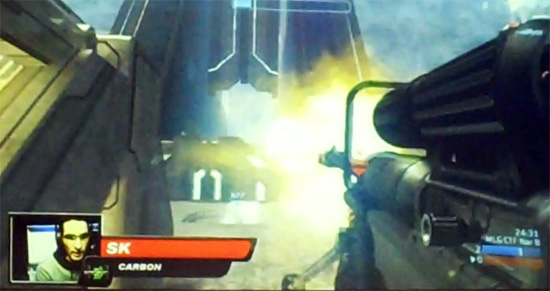
First-person shooters like Halo 3, featured at the Major League Gaming tournament in Raleigh Aug. 28, require quick reaction times from the world’s top players. | Image by Ross Maloney
With the release of the much-anticipated Halo: Reach on Sept. 14, I’ve spent much more free time than I’m willing to admit planted in front of my television locked in frenetic death matches with gamers around the world.
That hasn’t sat terribly well with my wife, who among other interests still enjoys occasionally hanging out with me for some reason.
But avid gamers with frustrated spouses, roommates and families take note: scientists have added another weapon to our arsenal of arguments that the benefits of action gaming go beyond geek cred.
The very same day Reach hit store shelves, the journal Current Biology published a report from the University of Rochester showing that gamers who spend their time playing shoot-em-ups are more effective decision makers.
Now that conclusion comes with a bit of a caveat, since “decision making” is a bit broad. What the scientists in the Department of Brain and Cognitive Sciences actually determined was that gamers are consistently better at “probabilistic inference” — essentially the act of evaluating the evidence before them and acting on it based on the chance it’s correct. What’s more, the scientists found that even non-gamers exhibited this improved probabilistic inference after they were trained to play video games for 50 hours.
To draw those conclusions, psychologists tested both gamers and non-gamers by asking them first to identify the collective direction of randomly moving dots on a screen. To prove the improvements were more than just visual, subjects took a second test asking them to determine which headphone emanated a sound masked with white noise.
The results were similar, even for those trained to play: the gamers made “more efficient use of the evidence.”
Interestingly enough, just being considered a “gamer” wasn’t enough to achieve that improvement. Non-gamers trained on EA’s Sims 2 scored similarly to non-gamers. It was the players who trained on Activision’s Call of Duty 2 or Epic’s Unreal Tournament 2004 who made the big gains.
And the researchers said they think they know why that’s the case.
“This type of learning may be a consequence of the nature of action video game training. Unlike standard learning paradigms, which have a highly specific solution, there is no such specific solution in action video games because situations are rarely, if ever, repeated.”
The Economist speculates that given the rise in popularity of action video games, society may see some collective benefits over time — better drivers for instance. That makes sense, since drivers are forced to quickly process their sensory experiences and react quickly based on that information.
Now if only science can prove being a gamer makes me a better husband, I’ll be all set.
Tyler Dukes is a freelance reporter and journalism adviser at N.C. State University. Follow him on Twitter as @mtdukes.
Female role in gaming industry grows
Friday, September 17, 2010, 11:59 am 3 Comments | Post a Comment
Phaedra Boinodiris says the Wii prompted a radical shift in traditional gaming industry marketing.
Women represent a huge portion of the market for the $10.5 billion video game industry. According to the Entertainment Software Association, females account for 40 percent of all players. At 33 percent of the gaming population, adult women even outnumber boys age 17 or younger. But despite those statistics, the male-dominated industry is still widely criticized for its portrayal of women.
But some female gamers, like IBM Gaming and Interactive Manager Phaedra Boinodiris, are working to change that portrayal – and get more women interest and playing and creating games. Science in the Triangle spoke with Boinodiris, the co-creator of WomenGamers.com, about the state of the industry and how it’s changing when it comes to women.
How did you first get into gaming?
My sister and I have been playing forever, ever since the days of Pong. I know that completely dates me – it’s scary. We knew we played and our friends played and our cousins played, but we’d open up most gaming magazines and look at gaming websites and they were targeted toward young men. So we decided to start a company, WomenGamers.com. That’s how we got the site of the ground.
How long did it take you when you were younger to notice how slanted the gaming industry is toward men?
It was gradual. I don’t know if you recall the first advertisements on television for the Atari or for ColecoVision, but if you take a look at what those looked like, you’d always see families playing together. Then there was this subtle shift in the kind of marketing that gaming companies were doing to focus more and more on a predominantly male audience. It was very interesting to us to note this shift.
So one day we were invited to a marketing to women online conference — this was back in the late 90s – and there was a panel on women in gaming. There was so much interest from big companies. Mattel, at the time, was really investing in that space. There was a lot of conversation about where this was going and how it was untapped. We just walked away thinking there was a lot of opportunity here to showcase this untapped market and really provide service.
Given the statistics about women gamers and gaming parents, why do you think the industry fails to market to women appropriately?
Because they have very few women working for them. If there were more women game designers, for example, if there were more women who were on staff working within these companies, you would see a bigger shift.
It wasn’t until Nintendo decided to make a play in that space to go after the more casual gamer that you would see huge changes in marketing and advertising. I remember before the Nintendo Wii, you would go to conferences like E3 – you would never see a poster of a woman actually playing a game. If you saw a woman, if she was depicted at all, she was typically in a chain mail bikini. But once the Nintendo Wii came out, there was a big push toward showing women playing.
They were on the frontier, and obviously they scored big with that. It wasn’t until after Nintendo made that big play that people started to wake up to this notion of the casual gamer and going after new blood. So you have more social games, like Farmville, mobile games, going after a bigger and bigger audience.

In Epic Games' upcoming Gears of War 3, communications officer Anya Stroud will hit the frontlines as a soldier. | Photo courtesy of Epic Games
Do you think the industry’s lack of female roles and often misogynistic overtones turn off female gamers who would otherwise want to play?
Absolutely. It perpetuates a stigma of what working within the game industry is like. It’s a shame because if women consider it as a boy’s club that’s really exclusionary, why would they ever try to, as their career, work there?
We really have a job to do to make sure the gaming industry itself is considered more inclusive so we can include more women who work there. This isn’t just to benefit women, by the way. You include women as game designers, you’re going to get whole new genres of games that don’t exist. I’m noticing with my daughter, she approaches certain games in a very different way. I’ve spoken with professors who teach game design and development classes who also remark upon the fact that the female students they have in their classes end up creating things that are really different from the status quo out on the market.
It will mean a lot more diversity in the market of games out there. Also, it means some serious profit for these game studios because they’re going after a larger and larger audience.

Intelligence officer Kat is second in command of Halo: Reach's Noble Team. | Photo courtesy Bungie/Microsoft Studios
In hardcore games, the female role does seem to be changing. We have female soldiers in the new Gears of War and Halo titles. Mass Effect 2 also has very prominent females as major players in the game. Are gaming companies starting to realize they need to put more females in these larger roles?
Actually, for the titles you mentioned, I don’t think they’re doing that to attract women necessarily. I think they’re primary reason for including women is for the men.
We’ve done a lot of studies and we’ve seen that a lot of the male game players prefer to play females, especially in [massively multiplayer online role playing games]. You ask them why, and they say, “Well they’re nicer to look at.” Secondly, they’ve found that when they’re playing a female character, a female avatar, others within the game will assume they’re a female playing. They’ve said they actually get a lot of free stuff – weaponry, swords, all kinds of things! It’s interesting to see the dynamic there in terms of the men choosing to play the female avatars.
Do you think one part of the solution here is sparking the interest of young women in math and science early on?
Absolutely, and my sister and I have done a lot of talks at elementary schools and middle schools about this subject. There’s been a huge drop in the number of women in math and science ever since the Bush era. One of the ways that we purport to be able to encourage women back into these fields is to encourage them to design games, early.
If you think about it, from my personal experience, the way that I got interested in math and science was absolutely because of games. It is a fun pursuit, especially the idea of designing your own. It’s play, if you will. What better way to get enthusiastic about subject matter than by playing in it to begin with? The idea is that you encourage young women, young girls to play these games, to design their own games, so hopefully they’ll be able to see why having a field in computer science or math or physics would be interesting.
Do universities have a role to play when it comes to encouraging women in science, technology, engineering and math fields?
Absolutely, but I think it’s a challenge. From an even earlier age than college, why is it that they’re being turned away from math and science? That question needs to be answered.
Whether it’s [creating] a game or a software application, it takes a lot more than programming. It takes good writing skills, good scripting, texture design, art, sound. In my case, for serious games, it takes a lot of business acumen and knowledge of complex systems.
For those women who think, “Programming is not really my thing,” that should not deter them from looking into this space anyway.
Was there a moment for you at some point in your childhood that you knew going into a science- or math-related field was for you?
It wasn’t a sudden thing. Both of my parents were retired IBMers and we had computers all the time in our house. They were very big on education and very big on math and science. It was something we always enjoyed and something we always loved and embraced. No one ever scared us off of that.
We were lucky to grow up in an environment that was very nurturing for us to like those fields and not feel like we’re eating our Brussels sprouts.
Looking forward, is there something that gives you hope about the future of the role of female gamers?
Everything I see. Look at the big push toward mobile gaming and casual gaming and what’s happening with the Nintendo Wii and how they’re outpacing everybody. It’s a huge wake-up call to companies. They’re really saying, “Gee, we really missed the boat. We really need to refocus on what we’re doing here. ”They’re looking at their staff and saying, “Who here knows how to target women? Who here knows how to make a gender inclusive game?”
They really are trying to learn at this point, not for good karma or altruistic feelings, but because it makes sense for the bottom line.
Tyler Dukes is a freelance reporter and journalism adviser at N.C. State University. Follow him on Twitter as @mtdukes.
Gaming in the Triangle gets serious
Thursday, August 19, 2010, 11:43 am 3 Comments | Post a Comment
Aten Inc.'s new free iPhone game Rhythmatical teaches students the connection between music and math.
Thomas Vaidhyan admits he can attribute much of what he’s learned about gaming to his young son.
When Vaidhyan, now the CEO of IT firm and game developer Aten Inc., first arrived in the Triangle, he realized quickly something was missing in the classroom.
“When I started getting involved with sending my son to schools here, I started researching quite a bit on that and found out very surprisingly, for me, a lot of the technologies and innovations that we’re getting incubated in our universities and developed in our industries weren’t necessarily percolating into our school systems,” he said.
To him, pulling gaming into the classroom was a no-brainer.
“It made a lot of simple common sense to use games for translating some of the abstract concepts in a very simple, easy-to-understand means to children,” he said.
That’s why his company, guided by a growing body of educational research, has been working to develop engines and applications in the rapidly expanding field of serious games, which teach and test users’ skills while they play.
Vaidhyan’s noticed the change in perception toward gaming, even in his daily life. After taking his son to a golf camp, he was surprised to learn the instructor rarely had to teach the complicated method of scoring anymore — his classes were already veterans of the fairways featured on Wii Sports.
“Five years ago when we were talking about it, people asked, ‘Are you crazy?’ But now everybody is understanding games can be a very effective tool,” he said.
The prevalence of devices like the iPad and smartphones is also expanding the potential playing field for educational games beyond the console and computer.
“You will see us moving more and more away from books and using devices like the iPhone and the iPad, where not only do you read, but that translates to a more visual and interactive experience,” Vaidhyan said.
Aten’s newest entry in the serious gaming field is a free iPhone app called Rhythmatical, which teaches about the connection between music and mathematics. It was created in collaboration with Virginia Tech and is targeted toward elementary school children.
It’s a far cry from blockbuster, next-generation franchises like Halo or Call of Duty: Modern Warfare, but Vaidhyan said that’s a good thing.
“Gaming companies and commercial games compete with movie productions — $10 million for one of those productions is considered to be cheap,” he said. “It definitely doesn’t scale to an educational environment.”

Other Aten titles, such as this classroom simulation, use virtual environments to educate users.
It’s that price point, Vaidhyan said, that’s keeping good serious games out of the fields of education and corporate training — but it’s also giving companies like his a unique opportunity.
“We’re able to get down to that and have a team and a framework where we can churn out these virtual environments at one-fourth or one-fifth of the cost that these gaming companies would take to create some of this,” he said. “One of the things that has kept us going in this field is the fact that we’ve brought ourselves to an attractive price point that can easily scale.”
Particularly in the case of 3-D gaming, some companies charge up to $250,000 just to license their game engines, or the software infrastructure that forms the foundation for different titles. The engines Aten uses, by comparison, can range from $1,500 to free.
For the average consumer, Vaidhyan said there’s a lack of good content on the market.
“The games that I’ve seen out there have been either gaming companies bringing them out themselves — which means commercially they’ll look good, they’re great games, but do not involve a lot of educational research background or aspects. Or, purely educational games that are boring,” Vaidhyan said.
He points out that demand is so high that teachers are learning to adapt existing games — like the multiplayer online role-playing game World of Warcraft — to their needs in the classroom.
But that dichotomy also presents a challenge for companies like Aten, which must balance a fun experience with applied learning.
“Where we could have a blend of this is where we can have success,” he said.
To do that, Aten pairs experienced game designers with experts from whatever field the title is trying to teach. The result should be what Vaidhyan jokingly termed “stealth learning.”

This Aten racing title requires players to learn more about car mechanics and engineering before modifying their vehicles.
“A successful education game is one where the user or the children don’t even know it’s educational,” he said. “They say it’s just another game.”
And like their commercial counterparts, serious games aren’t just for children.
Virtual Heroes, a serious gaming company also based in the Triangle, recently partnered with the Duke School of Medicine to develop a 3-D training game for the emergency room.
Aten’s also working on working with a major pharmaceutical company to create a simulated environment of their assembly line, allowing for virtual hands-on training without the risk.
“We have made it so simple for them that their assembly line workers can train themselves by pulling it out of their learning management system,” Vaidhyan said. “Here, they’d be doing exactly what they’d be doing on an assembly line, except they do it on a computer.”
Future corporations and classrooms could even implement a tracking component of the training and education module that would allow them to identify shortfalls — whether it’s a step of the production process or a mathematical concept.
“From a management perspective, you’re able to say, ‘This person is not getting this particular aspect,’” Vaidhyan said. “The management can give that person an individualized training.”
And solving the problem could happen almost instantly.
“You can give them formative feedback right in the virtual environment itself,” he added.
Outside the virtual environment, users of these technologies are learning something even more valuable — whether the game is serious or shoot-em-up. That’s another lesson Vaidhyan’s gleaned from his son, who often consults classmates when he’s stuck on a tough level.
“They are being forced to share best practices. They are talking to each other, figuring out how someone else is doing it and applying it,” Vaidhyan said. “That’s very valuable in the corporate world.”

Serious Gaming at Sigma Xi
Sunday, May 30, 2010, 10:33 pm No Comments | Post a CommentLast week I went to this season’s last American Scientist pizza lunch at Sigma Xi featuring Phaedra Boinodiris (Twitter, blog), Serious Games Product Manager at IBM.
I first saw Phaedra Boinodiris speak as the opening speaker at TEDxRTP (my review) back in March, but this was a different kind of talk, geared more towards scientists and science communicators.
I remember playing Pong when it first came out. I remember spending many hours back in 1980 or so playing The Hobbit on Sinclair ZX Spectrum. And I played many games at arcades (still not knowing which games started out as arcade games adapted to computers and which the other way round). Then I quit playing games for a couple of decades until my kids were ready for them. I loved Zoombinis - an amazing game of logic and a brilliant preparation for taking IQ tests! I loved Richard Scarry’s Busytown - the one and only game I know about infrastructure, where players build stuff and deliver it to others for the good of the town - from baking bread to paving roads - learning along the way how those things are done.
And sure, Phaedra Boinodiris started with a slide depicting Pong (to the chuckle of the audience) but soon got into the real stuff - the serious gaming and the story of how she got involved in developing such games, as well as about studies of gaming and how different kinds of games help develop different real-work skills, from eye-hand coordination to leadership to cooperation. Her first game - INNOV8 - was developed as a prototype, a proof of concept, in only three months and instantly became a huge hit. It is used by businesses and business schools around the world to teach Business Process Management. It is essentially a first person shooter game (without guns) in which the player is brought as an outside consultant into a company where s/he has to figure out the flow, the bottlenecks, etc. (including by interviewing employees, as well as data-sheets) and experiment in making it more efficient. The 2.0 version came soon after, adding such problems as traffic, customer service and supply chains.

The next game, recently announced and coming out in October 2010, will be a Sim-City-like serious game CityOne, designed to help city planners, town councils, citizens, and engineers plan better, more efficient infrastructure for their cities. Put in your city’s specs and start building new infrastructure, see how much it will cost, see what problems will arise, see what solutions are available - probably something you could not have thought of yourself and may be surprised.
As I am currently reading ‘On The Grid’ it occured to me that the developers of CityOne should read that book, and that Scott Huler should be given a test-run of the game, perhaps for him to review for Charlotte Observer and Raleigh News&Observer and the local NPR station. And for Science In The Triangle, of course.


