Author Archive

7-year-old dino digger strikes rare fossil gold
Thursday, August 25, 2011, 11:26 pm No Comments | Post a Comment
Jesse digging with his grandfather, Barry
Seven-year-old Jesse might have been enjoying his summer off from school, but on July 13, he uncovered a big lesson on science and paleontology.
Jesse was pawing through the dirt of the fossil dig site at the Museum of Life and Science in Durham when all the sudden he hit something big: a symphesial cow shark tooth.
This type of fossil is considered to be extremely rare, said museum marketing director Taneka Bennett.
How rare exactly?
“The cow shark tooth is believed to be between 10 and 15 million years old,” said Bennett. “Finding one in such pristine conditions is particularly unlikely, let alone at all.”
Best of all, everything visitors find in the dig site is theirs to keep. Jesse’s mother Amanda Duncan made sure her son took his newfound treasure home to Havelock, N.C. When they got there, Duncan said she researched the fossil on internet paleontology forums.
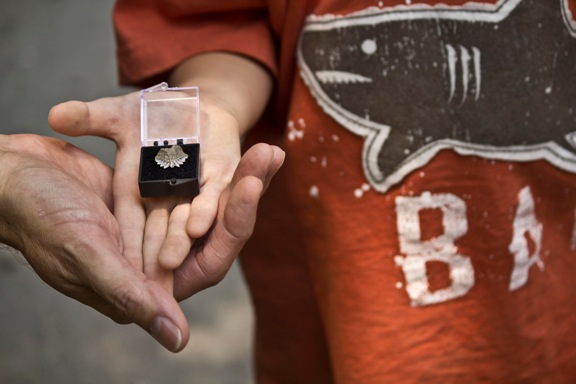
A symphesial cow shark tooth (above) in such good condition is extremely rare
“I posted an image along with a description where the fossil was found and responses poured in,” she said. “One collector described the piece as the ‘Holy Grail’ of sharks teeth. “
Jesse was offered $400 by one collector for said Grail, but his mother said it is too important to Jesse’s growing up to be sold. Currently, it’s on display at the museum. When it finally comes home to Havelock, it will reside in Jesse’s safe deposit box.
Bennett said even though summer is the busy season for the dig site, she has noticed a boon in visitors coming to ask about their fossil finds in hopes that they are also as valuable.
Dirt in the dig site is imported from the Aurora phosphate mine in Beaufort County, N.C. It is filled with fossils estimated to be between five and 25 million years old.
At one point in prehistoric development, part of North Carolina was believed to be covered by water. Thus, the cow shark fossil might have come from that portion of the Atlantic Ocean.

A keepsake for his childhood
POZEN’ a threat to outdated pharma marketing
Thursday, May 26, 2011, 3:42 pm No Comments | Post a CommentOriginally published on TheRTP Blog, 5/25/11. Watch The RTP’s exclusive sit-down interview with Liz!
For 25 years, Liz Cermak worked for Johnson & Johnson, one the biggest names in the pharmaceutical business. Now, she works for one of the smallest. And she says in terms of marketing, it’s giving the Goliaths a run for their money.

Cermak is the executive vice president of POZEN, Inc., a Chapel Hill-based pharma developer/manufacturer with no more than 30 employees. Since coming onboard in 2009, she has overseen the company attain FDA approval on two authentic combination drugs: Treximet and VIMOVO—for migraines and osteoarthritis, respectively. No small feat, even by J&J standards.
But what Cermak is most excited about is POZEN’s fresh and unique approach to pharmaceutical marketing.
Instead of sending sales representatives to hospitals and doctors’ offices to promote their products, Cermak and her team pitch most their medicines online.
“The reality is that the current sales rep model of traditional pharma is obsolete,” Cermak said to a packed house at the Marketing Mondays series held at The Research Triangle Park HQ earlier this week. “Eighty-six percent of US doctors go online for product info now, and 82 percent are on smart phones.”
In-person sales pitching can be inefficient, she said, because all health care workers are overbooked and overbusy, and representatives must endure a costly wait just to get two minutes in with the doctor.
Two minutes. That’s the average rep-doc face time. But online, the average time spent by a physician on a single ePromotion activity is eighteen minutes.
Cermak has three rules for digital pharma marketing:
1. Develop products that deliver real value to customers.
Be relevant and learn from your customers. Understand their needs and study their e-behavior. Most pharmaceutical companies need to broaden their apertures here, she said.
2. Make them affordable and accessible.
POZEN recognizes the strains today’s pharmaceutical pricing puts on doctors and patients today alike. As should go without saying, costs must be kept low to compete and to demonstrate a respect for your consumers.
3. Engage with customers in a meaningful but highly efficient way.
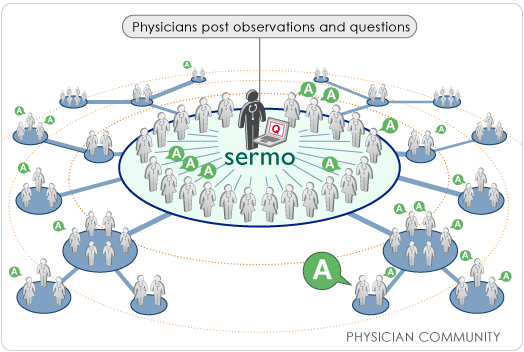
This means using social media and online public networks like Facebook and LinkedIn, but also more exclusive, MD-only communities like Sermo or CogNet. Use push and pull marketing tactics; see what works and what doesn’t.
Cermak calls this “Pharma 3.0”.
“The change isn’t coming,” she said. “It’s here.”
We’ve seen this before with other industries, as well. Amazon now sells more books for the Kindle than it does in print, and Netflix’s superior, customer-based business model has Blockbusters closing up shop around the country. The global economy is now decidedly digitalized and will only continue to shift that way.

Now, as POZEN enters the final testing and approval phase for its latest development, an ulcer-reducing aspirin compound dubbed PA32540, a viral campaign is already underway to spread the word.
Cermak stressed there is still utility in face-to-face interaction, though. Sending sales reps is important to explaining drug principles to doctors, learning about clinic demographics, and building a personal rapport with primary care physicians. However, there are not enough reps to go around as it is now, and focusing sales online will drastically cut down their jampacked schedules.
The biggest advice Cermak has for pharma companies looking to try this new approach is to not be afraid to experiment. To take risks. And to lose.
“Be ready to try and fail,” she said. “Absolute ROI of a given digital initiative cannot be accomplished with a high degree of certainty.”
No one expected it to work out for POZEN. But no one expected 30 people from Chapel Hill to get two drugs FDA-approved in two years, either.
Adolescent binge drinking linked to permanent brain damage
Friday, April 29, 2011, 8:09 pm No Comments | Post a Comment Sobering news for underage drinkers: adolescent binge drinking can lead to irreparable brain damage as an adult.
That’s what a new study from the Bowles Center for Alcohol Studies at UNC-Chapel Hill’s School of Medicine found.
It also found striking figures as to just how many adolescents are binging when they drink. Forty-four percent of college students reported heavy alcohol intake in the last two weeks, 28 percent of twelfth grade seniors, 22 percent of tenth graders, and, finally, 12 percent of eighth graders.
Adolescence, between ages 12 and 20, is a period of critical growth for the human brain. The adolescent brain is much more sensitive to changes induced by alcohol than a fully matured one. With so many teens drinking, the country’s youth are at risk for under-developing their adult brains, said Dr. Fulton Crews, the director of the Bowles Center and the lead pharmacologist on the study.
“We found that alcohol exposure changes genes in the brain,” Crews said. “And actually shrinks part of the forebrain, resulting in a loss of acetylcholine molecules.”
Acetylcholine is a key neurotransmitter involved in both the central and peripheral nervous systems. He said alcohol can also heighten impulsivity in adolescents—not just in the moment of intoxication, but down the road.
“As you mature, you become less impulsive,” Crews said. “And if you’re drinking young, it seems to disrupt that maturation. If you started drinking as an adolescent, you’re more likely to get in a fight.”
However, Crews makes a distinction between impulsivity and aggression. Aggressive people, he said, are angry and violent, whereas impulsive people have a hard time controlling their immediate urges.
The next logical step, Crews said, is to examine whether adolescent binge drinking increases chances of depression, anxiety or personality disorders.
“I think it does, but right now we really don’t have the data to back it up,” he said. “What we do have makes us lean that way.”
The study can be found in the April 2011 edition of Alcoholism: Clinical and Experimental Research.
Dr. Martin Styner is the co-director of UNC’s Neuro Image Research and Analysis Laboratories (NIRAL). Styner helped Crews develop computer tools and MRI programs to measure which parts of the brain are affected by alcohol. The statistics on adolescent drinkers did not surprise him.
 “Adolescents would be more likely to drink because of the current social acceptance of it,” he said.
Currently, though, there have been no actual long-term tests on humans. All MRI data instead came from rats, Styner said. He claims the research with regards to adolescent binge-drinking is just beginning for him and his team. Next, they will investigate the connectivity between different parts of the brain and how drinking can spawn a chain collapse in neural networking.
Crews said he hopes this information will help prevent teens and adolescents from drinking so much. He also said it might motivate parents to see underage drinking as something more than what he called “transient intoxication”.
“I read stories where parents say, ‘the problem with underage drinking is the traffic accidents’,” Crews said. “‘And kids do it because it’s forbidden fruit, so I’m going to let them drink in my house’. But it’s also hurting their brain, and they need to hear that.”
Carrboro Police Sgt. Chris Atack said the hardest part of enforcing underage drinking laws is a general lack of adolescent supervision by parents.
“I do it myself with my 4-year-old,” Atack said. “You think they’re older or more mature than they really are.”
From a law enforcement standpoint, he said, it’s very difficult to control what goes on inside a private residence because officials are rarely alerted until it becomes a problem. Atack said he, too, was not stunned by the study’s statistics on how many adolescents binge drink.
“It is what it is,” he said. “In a lot of ways it’s unfortunate, but it’s not surprising.”
Crews said he absolutely supports the drinking age being 21, for medical reasons. Right now, the law is in place only because of the amount of how many people are killed by drunk driving, he said. It has nothing to do with biology or neurological effects, he said, and that’s something he wants to see change.
“I have kids of my own,” Crews said. “I’ve been lucky that they don’t have drinking problems. I’m not sure I can say I controlled all aspects of their development.”
Only 8% of asthmatic children using inhalers properly, finds UNC study
Friday, April 8, 2011, 1:48 pm No Comments | Post a CommentOriginally published: 3/31/11
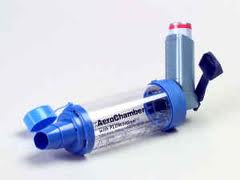
Only eight percent of children with asthma are using their metered dose inhalers properly, finds a new UNC study.
That figure alone is enough to make parents short of breath. However, the study also found that kids aren’t using their inhalers properly because their primary care physicians aren’t showing them how.
The findings appear in the March edition of the online journal Pediatrics.
Dr. Karin Yeatts, an assistant professor of epidemiology at the UNC Gillings School of Global Public Health, was involved in the study. She cautioned asthma users to make sure they know how their medicine works.
“If you’re not taking it properly, then a lot less of that medication is reaching your lungs and reducing the inflammation,” she said. Yeatts said physicians and pediatricians need to spend more time demonstrating inhaler techniques with younger patients.
“Often the parent gets shown, but we found that the more competent the child is, the more likely he or she is to inhale the medicine correctly,” she said. “Sometimes the parents aren’t around when they need to take it and the people at school might not know.”
There is a proper technique to taking asthma medication, said study co-author Dr. Stephanie Davis of the UNC Division of Pediatric Pulmonology. Davis’s instructions were:
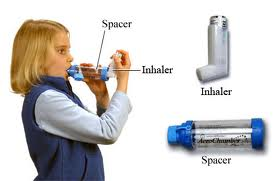 1. Shake the medicine canister.
2. Exhale completely.
3. Connect spacer and place in mouth.
4. Seal lips around spacer.
5. Take a big breath and hold for 10 seconds.
6. Exhale, wait, and repeat.
Davis said how many puffs you take depends on how severe your reaction is at the time. Most asthmatic children take the medicine twice a day. If you’re about to go running, Davis said you’d take it right before warming up.
The spacer, she said, is what makes all the difference. Spacers are small plastic tubes that connect to the inhaler to better corral the spray down into the lungs. The most common problem without a spacer is hitting the back of the mouth and not getting the actual dose of medicine to the airways. Even though Davis said spacers aren’t always necessary, she gives them to every child in her pulmonary clinic, whether six or eighteen.
“I ALWAYS recommend a spacer,” she said. “In fact, I have asthma and I always use an inhaler with a spacer, as well.”
Davis and Yeatts agree that the overriding reason primary care pediatricians aren’t showing kids how the inhalers work is because they are too busy.
“That’s sort of the reality of clinical practices these days,” Yeatts said. “Pediatricians have so many things to do every day that it’s not that high up there for them. But still, why don’t they?”
Dr. Janelle Shumate just finished her residency at UNC Hospitals. Now she’s a full-time pediatrician at Village Pediatrics in Chapel Hill. Shumate said she and her colleagues always sit down with asthma patients and show them how to take their medicine.
“It only takes five to 10 minutes,” she said. “And usually closer to five.”
Shumate said Village Pediatrics has sample spacers and inhalers that kids can test out or watch a demonstration on.
Jonathan Fowler works alongside Shumate as the clinic’s practice manager. He said not showing patients how the treatment devices work is not only poor care service but a violation of the American Medical Association’s protocol guidebook. Village’s policy is always to show kids how, he said, and they’re able to because they see less patients.
“We’re spending more time with the kids than other pediatric offices,” Fowler said. “A lot are trying to see 6 or 7 an hour. It’s not like they wouldn’t do it if they had the time. But they don’t have the time.”
Taking the extra time pays off, too, he said. Insurance companies reimburse them for instruction time as a measure to lessen chances of hospitalizations down the road.
“Not only do we teach them, we bill for it,” Fowler said.
Still, Davis sees rising customer demands and health care rates as the barrier to entry for thorough asthma medication instruction.
“As we currently buckle down on costs, it’s going to be harder and harder to be able to do that,” she said. But because asthma is so prevalent in the pediatric population, she said it’s critical.
“I’m biased because I’m a specialist and I always have the means to do so. But many others don’t.”
April 1st kicks off 5th annual SmartCommute@RTP Challenge
Monday, April 4, 2011, 1:59 am No Comments | Post a Comment
Originally published 3/24/11:
Saying Jim Miller likes to bike is an understatement.
The 55-year-old facility engineering manager at Research Triangle International said he rides his Cannondale road bike to and from work every day of the year, including winter.
“I’ve biked when it’s 15 degrees Fahrenheit outside, and I’ve biked when it’s 105,” Miller said.
He estimates that he’s cycled between thirty and forty thousand miles between work and errands in the last three years. So naturally, each year Miller pledges to participate in the RTP SmartCommute Challenge.
The 5th annual challenge, which runs from April 1st to June 1st, encourages residents and employees in Wake, Orange and Durham counties to explore alternative modes of transit to work. In addition to biking, popular options include walking, carpooling, taking the bus, and telecommuting.
“Telecommuting is the most popular SmartCommute alternative in the region,” said James Lim, director of RTP programs at the Research Triangle Foundation.
Lim helps coordinate SmartCommute. He said one of the major benefits of taking the challenge is reducing the number of vehicle miles traveled. Along with this comes improved air quality, which includes reductions in CO2, mono-nitrogen oxides (NOx), and volatile organic compounds (VOCs).
Lim and his colleagues on the SmartCommute committee have established two goals for this year’s challenge: trying to save around 18,000 gallons of gasoline and trying to recruit 12,500 pledges. He said last year’s goal of 10,000 pledges was met and surpassed.
But to talk the talk, Lim feels he must walk the walk, literally. He plans to jog seven miles to the RTF headquarters from Durham each morning over the course of the two months.
“Now that I’m saying this in print,” Lim said. “I have to do it.”
He also carpools with another Foundation coworker. It’s important that employers are supportive of their staffs’ efforts to join the challenge, he said. Some companies have flexible starting and leaving times for those who bike or walk; others issue carpool parking passes closer to the building.
Darren Danko, the information technology director at RTF, is an avid SmartCommute cyclist as well, though admittedly he’s not as hardcore as Miller.
“I’ll bike whenever it’s 60 degrees or above,” Danko joked. His 3.2-mile ride from Durham takes him about 20 to 25 minutes on his aged, 10-speed Schwinn street bike.
Danko also opts for eco-friendly transit even after the challenge is over.
“It’s important to let people know that there are other alternative ways to get to work,” he said. “People need to get off their butts and do some exercise.”
According to past survey data, 75 percent of SmartCommuters elect to maintain the challenge after it comes to an end, Lim said.
Their efforts aren’t without incentive. Lim’s committee sponsors a SmartCommute Challenge awards ceremony each summer wherein companies and employees who participate are honored for their achievement. Two grand prizes of $750 are handed out to a pair of individuals who distinguish themselves.
This year there are two prize pools: one for new pledges trying green transit for the first time and one for veterans who continue to reduce their carbon footprints to work.
SmartCommute is co-sponsored by GoTriangle, a regional collaborative of transit providers. Research Triangle-based corporations like IBM, Cisco and Miller’s RTI also donate to the program.
Miller bikes twelve miles from his home in Chapel Hill to RTI’s headquarters in Research Triangle Park, a 24-mile roundtrip per day. He said it takes him about 45 minutes each way. Over the course of last year’s challenge, Miller rode more than 612 miles. It’s a part of who he is.
“I biked a lot when I was in my early twenties,” he said. “And I started again after I divorced 13 years ago.” His biggest ride was a coast-to-coast excursion in 2003.
He doesn’t see any downside to leaving the car in the garage. The only the cycling becomes a problem, he said, is during right turns at intersections with drivers jetting out behind him.
“I’ve only been hit by a car one time,” Miller said. “No accident, though. They just hit me in my arm with their side view mirror.”
Humans, monkeys age the same, say Duke primatologists
Sunday, March 27, 2011, 7:13 pm No Comments | Post a CommentOriginally published: 3/17/11

Studies find the muriqui monkey can live as long as the average human being
Humans share 98 percent of their DNA with monkeys. Clearly, the two species have a few things in common. One, say researchers from Duke University, is how we age.
Dr. Susan Alberts, a Duke biology professor, has been studying baboons in Kenya’s Amboseli National Park for quite some time. In fact, she’d just gotten off a flight home, she mentioned when interviewed.

Dr. Susan Alberts
Alberts is one of several Duke scientists who have teamed up with universities across the world to study aging behavior in wild primates. She said data was combined from seven different studies on non-human primates, each spanning 25 to 50 years. Two of these—the Jane Goodall Institute study on chimpanzees and Alberts’s Amboseli study on baboons—were based at Duke.
Findings from the studies appear in the March 11 edition of Science.
The studies chronicle primates over the course of their lives. Monkey populations were observed for births, deaths and physical deterioration. Alberts said long-term primate studies like these are invaluable to putting the human experience in perspective.
“Before, we didn’t have anything to compare to that was like us,” Alberts said. “So we were comparing ourselves to lab mice. And we are really different than lab mice.”
Dr. William Morris, a Duke ecology and population biology professor who assisted Alberts, said main conclusion of the report was that aging patterns and mortality risks coincide between humans and non-human primates.

Dr. William Morris
“Your chance of dying increases with age in a similar way whether you’re a gorilla or a baboon or a human,” said Morris. “Humans still win, but we’re not too far away from our primate relatives.”
According to the report, female chimpanzees often live into their forties, some even into their fifties. Males live into their thirties but are mostly dead by their early forties. Morris said the monkey with the longest life expectancy was not the chimp or gorilla, but rather the lesser-known Brazilian muriqui, which can survive all the way into its seventies.
That is not too far off from the average life expectancy of a human, said Dr. Anne Pusey, chair of Duke’s evolutionary anthropology department. Nowadays, the typical American male will live into his eighties. Females, she said, live slightly longer. The gender difference is more pronounced in monkeys, though, because of male-male competition for reproductive opportunities with a limited number of females.
Pusey has been working with renowned British primatologist Jane Goodall at her chimpanzee park in Tanzania since 1970. In the wealth of data she’s collected over four decades, she has developed an eye for identifying chimp aging behavior.

Dr. Anne Pusey
“Just knowing more about mortality patterns in other species helps us think about the evolution of our mortality patterns and understand which patterns are fixed and which are more elastic,” Pusey said. In the future, she and her colleagues plan to investigate how reproductive rates change with age.
“Humans are unusual in this regard because we hit menopause and continue to live a long time afterwards,” she said. “But female chimps go on having babies up until they die.”
Pusey took on her job at Duke last year. She said she was attracted to the area because she feels it’s one of the best of its kind in the country. Also, she had heard about Dr. Alberts’ study and discovered how much potential there is for primate research in the Triangle region.
Alberts said she’s interested in how animals use social behavior to solve environmental problems and how that impacts their survival. What characterizes the human race, she said, is that we’re primarily monogamous, which levels out competition among males.
This might seem counterintuitive at first. If females only mate with one male, wouldn’t there be increased drive for men to settle down with the most desirable female? Alberts said it is actually a great equalizer for the men, and everyone still ends up with a partner.
However, in non-human primate species, not everyone does. The females mate with multiple fathers, but not every male passes that litmus test.
“If females only mate with one male, it isn’t how many kids he’s going to have but how good a mate he’s going to get,” she said. “In primates, the least successful male wouldn’t have any kids at all.”
One finding that surprised her was that primate males are able to differentiate their own offspring. She found this remarkable since females mate with many different males in the course of a lifetime and there’s no discernable way for fathers to keep track of who’s whose. Paternal care goes very deep in our primate roots, she said.
“Human males are very good fathers, especially compared to most mammals,” said Alberts.
So in a lot of ways, socialization has factored into reproduction and life expectancy. Insight like this, Morris said, paves the way to understanding how human evolution has digressed from that our hairy ancestors.
“We live longer than the other primates because of the environment we create for ourselves,” he said. “Nutrition, modern medicine, health care—other primates don’t have these things.”
To Morris, the importance of the Amboseli study is in advocating long-term primate research because he thinks that’s how we really learn about the aging process. He said it’s much different than the plants he studies.
“With trees you can take a look at the core and see how old it is,” Morris said.
“You can’t do that with baboons and monkeys. You really need to follow them around to get the whole picture.”
RF radiation harmful to humans? Sent on my iPhone.
Saturday, March 12, 2011, 12:08 am 2 Comments | Post a Comment
A graphic depiction of radiofrequency (RF) radiation (picture via TopNews.in)
Cell phones continue to become more and more prevalent, but so does a debate in the scientific community as to whether they do more harm than good.
That’s why the National Toxicology Program (NTP), a subset of the National Institute of Environmental Health Sciences based in Research Triangle Park, is studying the effects of cell phone, or radiofrequency (RF), radiation on animals.
So far, there is no evidence to suggest any short- or long-term damage to humans, said Dr. Mike Wide, an NTP toxicologist involved in the study. There are two types of radiation, he said: ionizing and non-ionizing.
“Ionizing is what most people are familiar with,” Wide said. “Things like X-rays and nuclear bombs.” Ionizing radiation will strip electrons away from atoms and molecules and thus has the potential to cause ionic damage in tissue.
Meanwhile, non-ionizing radiation—which includes radiofrequencies—is much lower in intensity and does not endanger ions. It can heat things up, though.
“When the power level gets high enough, eventually the RF radiation energy starts to excite molecules and creates heat, like a microwave,” Wide said. “Increase someone’s body heat enough, and you’re eventually going to have a body of problems.”
This is called the thermal effect. Wide said although the potential for such damage exists, there is currently no reason to believe RF radiation could harm human tissue.
Not all his colleagues share this belief. Wide was part of a cell phone radiation expert panel that testified before Congress in 2009. Dr. Devra Davis of the Environmental Health Trust was another panelist.
Davis said the evidence clearly shows cell phones cause physiological harm in humans.
The thermal effect created by the phones can alter brain metabolism and glucose, she said. This could be especially detrimental to children, whose brains are still developing and who absorb twice as much radiation as adults.
There could be sexual side effects, too. Davis said there is a 50 percent reduction of sperm count in young men who keep cell phones in their pockets for four hours a day.
“Just by keeping it in your pocket, you exceed the FCC limit,” she said in reference to the Federal Communications Commission’s standard on cell phone radiation emission rates.
Currently, the maximum Specific Absorption Rate (SAR) for commercial cell phones is 1.6 megawatts per kilogram (MW/kg), a number developed in 1996 on recommendations by top scientific agencies like the EPA and the FDA. This rate measures the amount of radiation that is absorbed over one gram of tissue when the phone is using its maximum power, explained Wide.
Phones are rarely using their maximum power and this SAR ceiling is well below the threshold for actual bodily harm from radiation, said Bruce Romano, associate chief of the FCC’s office of engineering and technology.
“It’s a safety mark intentionally set that low,” Romano said. “Artificially low, even.”
The phones, he said, would have to emit much more than 1.6 MW/kg of RF radiation to cause any acute human damage, so everything below that level is safe. Some mistakenly assume a SAR of 1.2 is safer than a SAR of 1.4; however, as long as they’re below 1.6, all SARs are equally safe, he said.
“If you’re moving under a 12 foot bridge, what’s the difference between a nine and ten foot truck?” Romano said. “They both fit under.”
Davis argues the best way to reduce the risk of harmful radiation is to use a head-set or turn on the speakerphone. She helped found the Global Campaign for Safer Cell Phones, along with CNN medical commentator Dr. Sanjay Gupta.
The campaign advises against regular use and carry of cell phones and advocates safer model designs. Yet, Romano is not sure better designs are the answer.
“At this point, they’ve probably done everything they can do design-wise,” he said. “The next thing would be to lower the power, but then it doesn’t work as well or you need more base stations.”
What Wide points out is that the FCC’s standards are based on protection from acute injury. They are not designed to guard against long-term effects from repeated low-level exposure to thermal energy.
“That’s one of many reasons why we’re interested in this study,” Wide said, explaining that current regulations are not based in real life data, as far as the way people are using cell phones. He said 85 percent of Americans and four billion people worldwide use cell phones regularly.
“Even if there’s a small effect, with so many using them, it could affect a lot of people,” he said. “It will definitely remain an issue for several more years to come.”
Davis, on the other hand, said the time to act is now. Changes must be made to shield the younger generation from chronic exposure.
“We do not have the answers, but when should we have asked against tobacco or asbestos?” she said. “If we have to wait on proof for cell phones like with these, we’ll end up with dead bodies, of our children and grandchildren.”
Wind technology might harm N.C. environment it seeks to protect
Saturday, March 5, 2011, 5:04 am No Comments | Post a CommentOriginal publication: 2/24/11

When listing off renewable sources of energy, wind almost certainly comes to the forefront. Wind technology is associated with being clean, sustainable, and endless. What people often overlook, however, is its potential damages to the environment it seeks to protect.
Wind turbines have become a leading alternative source of energy to fossil fuels around the world, and now North Carolina is preparing to build structures along the coast and the eastern part of the state. Federal and state officials have formed a task force to begin mapping and planning, said Seth Effron, communications director for the North Carolina Energy Office.
Still, some citizens and scientists alike are concerned about the potential environmental hindrances wind turbines would create. They feel the harm to the land might outweigh the help.
A June 2009 study from UNC-Chapel Hill on the feasibility of the wind turbines for eastern North Carolina found several potential dangers with the project. Among them: the displacement of species, the destruction of habitats, and even the killing of birds in some cases.
Harm to Wildlife
Dr. Stephen Fegley, an associate professor at UNC’s Institute of Marine Sciences in Morehead City, co-led the study. He explained that turbines are installed with large, loud pile drivers that often scare off marine life temporarily.
“Based on the wind farms that have been created in Europe,” he said. “As soon as the piling began, the marine mammals swam away. As soon as the pile driving was over, they eventually came back.”
Fegley had not seen any negative effects on the animals under the water, although, in some instances, he had with those above.
“Even in the case of the existing wind farms, some are associated with a fairly large mortality of birds,” he said. It depends how the birds utilize a certain area, whether they feed on it or use it as a corridor for migration.
However, in some cases, he would observe the opposite. Fegley and his colleagues learned the turbine structures provided a basis for mussels and worms to grow on, like barnacles on an old ship. This in turn would bring more fish species into the area. In these cases, having the large wind structures proved very beneficial to the local ecosystems.
Power cables ruining land
The power lines connected to the turbine structures carry the potential to disrupt the surrounding marsh and topsoil. Initially, Fegley said, the land must be trenched, which would displace sea grass and could cause local terrain damage. It could also disrupt certain fisheries.
“There’s some evidence that the magnetic fields the cables create might disturb sharks and fish,” Fegley said.
It’s completely dependent on the area, though. In parts where cables would not cross any grass habitats, the equipment is not as hazardous.
There are plans to start designing floating turbines, which would operate much farther offshore, but costs are currently too high and no one has been able to test its effects on the ocean floor. Although Fegley said offshore turbines are generally considered safer than those onshore, he does not think having them float is a good idea.
“I legitimately think that would come to a point where it would completely change the landscape,” he said. “It could be quite objectionable.”
Aesthetic Objections
Another major complaint about the turbines is their obstruction of nature. Residents in counties considering wind projects have expressed a concern that the structures will interfere with their outdoor viewscape or with their recreational use of the water.
In 2009, the state Senate voted 42-1 to ban wind turbines from western North Carolina after an overflow of complaints about their running the scenery. National headlines and columns were written about how North Carolina voted down wind energy because it was “too ugly”. The bill was not taken up by the House.
But Julie Robinson, communications director of the North Carolina Sustainable Energy Association (NCSEA), said she thinks something has changed since then.
“I really think over the last three years, there’s been so much discussion and education and definitely more advancements in the technology,” said Robinson.
“In both the mountains and the coast, once people who expressed an early opposition hear more about the technology and the potential benefits, they become more supportive.”
The key to this, said Robinson, is conducting more conversations with local communities and disseminating information on project proposals. Iberdrola, the Spanish company that just announced construction of a 300-megawatt wind plant outside Elizabeth City, has been meeting with different groups there to discuss its intentions for more than a year.
Obama’s budget proposal affects NC energy, environment
Monday, February 28, 2011, 5:35 pm No Comments | Post a Comment
Graphic breakdown of the President's proposed 2012 fiscal budget. (via New York Times)
President Obama’s fiscal 2012 budget proposal aims to scale back spending in big-ticket areas like defense and homeland security. However, a lot of science and research-related sectors would see a boost in funding.
This stays in line with Obama’s January State of the Union promise for America’s “Sputnik moment” and his call for heightened investment in innovation. It also comes at a great time for North Carolina, which continues to place increasing focus on climate and alternative energy.
Still, not all research and development (R&D) programs would receive equal allotment. Some departments, like the Environmental Protection Agency, would see budget cuts if the president’s proposal passes through Congress.
Here’s a breakdown of how the budget proposal will affect two of the largest science and R&D-related fields: energy and the environment, both on a national and local level:
Energy
National: Clean energy and alternative fuel initiatives would reap a big boost from Obama’s budget pitch. The Department of Energy’s spending budget would climb a total of 12 percent. Discretionary spending would increase almost 40 percent from 2010 to $11.84 billion. That’s roughly $104.18 per household. Measures here would include investments in renewable sources of power like wind and solar—which would jump 70 percent from last year—and the push for all-electric vehicles.
Studies on hydrogen as a clean alternative to fossil fuels will incur significant cuts, losing $70 million. Federal energy assistance to low income homes would also be reduced.
Local: North Carolina will spend a total of $75.9 million on the state energy program, with $20.9 million for energy efficiency and conservation block grants. Within Orange County, grants include installing a new solar heat pump and a high-efficiency hand dryer at the Emergency Services building, improving lighting at Triangle Sportsplex, and adding a solar hot water heater at the Piedmont Food & Agriculture Center. Total project expenditures estimated at $451,350. A $1.4 million grant will go towards energy-efficient agricultural storage equipment.
So what is that money going towards, specifically?
“Right now, it’s solar and wind energy,” said Seth Effron, communications director for the North Carolina Energy Office. “You’re going to see very significant acceleration in the next year and a half.”
Effron said the federal government has just initiated a variety of steps to start leasing offshore sites for the development of wind energy. N.C. Gov. Bev Perdue has created a scientific panel on offshore energy for the eastern part of the state.
“People here are very interested in moving ahead,” said Effron. “Particularly with how it relates to an exploration of offshore petroleum.” He cited a June 2009 UNC study conducted by the General Assembly claiming North Carolina has the best offshore wind resources of any state on east coast.
Right now, almost all the State Energy Office’s budget comes from the Washington-led American Reinvestment and Recovery Act, but that expires in 2012.
Environment
National: As a whole, the president’s budget allocates $6.27 billion for Environmental and Other Defense Activities, down 4.6 percent from 2010. If the White House’s proposal passes, the EPA would lose 3.2 percent of its current research budget.
EPA Administrator Lisa Jackson said the agency will receive $8.97 billion, pending Congress’s approval, in a press conference Monday. More than $1.4 billion will be lost after an all-time high of $10.3 billion in federal funding last year.
Jackson said losses will include cuts to the Great Lakes Restoration Program and so-called “superfunds” which give the agency oversight of environmental repair on federal facilities.
These cuts would be offset in part by additional funding to the Science To Achieve Results (STAR) academic grants program.
Local: In tandem with Obama, Gov. Perdue included substantial reductions to environmental programs in her 2011-2013 budget proposition released Thursday. Among them comes the elimination of 224.5 Department of Environment and Natural Resources (DENR) jobs. Meanwhile, her plan appropriates roughly $180 million over two years to pursue DENR’s outlined 2009-2013 goals: sustaining clean air and water for future, growing a green economy, conserving natural worklands, and responding to climate change.
The EPA has a satellite facility in the Research Triangle Park, but it’s still a limb of the national headquarters, said senior press officer Cathy Milbourn. Milbourn said the budget committee is only now beginning to assess the president’s proposal and how it will affect the agency. She also added that it needs to pass through the House and Senate before anything is set in stone.
Susan Massengale, spokeswoman for NCDENR’s Division of Water Quality, said all environmental agencies have had funding constraints over the last year, and hers is no exception.
“We have very local budget issues with both the governor and the state legislature in town,” said Massengale. “In any case, we’ll use the money we have in the most efficient way and protect the state water quality to the best of our ability.”
Massengale’s division is working to establish a statewide water quality policy and to combat pollution with new wastewater infrastructure.

[Author's note: Wind technology--and specifically its non-immediate drawbacks--will be discussed further in the next article.]
UNC neuroscientists tackle head trauma issues in football players
Thursday, February 17, 2011, 3:05 pm No Comments | Post a CommentOriginally published: 2/10/11
 A record 111 million people tuned in for Super Bowl XLV Sunday night, analyzing everything from the agility of the running backs to the facial theatrics of the coaches.
What many likely did not consider is how dangerous the hits and tackles can be to players’ heads. In many cases, it can result in concussions and permanent brain damage.
This is not uncommon, either. In fact, the average UNC football player sustains 950 hits to the head per season, says Dr. Kevin Guskiewicz, chair of the school’s exercise and sports science department. He and fellow neuroscientists at the Matthew A. Gfeller Sport-Related Traumatic Brain Injury Research Center, located on UNC’s campus, are making it easier to monitor high impact head knocks on the field.
This could prove invaluable in learning how long-term exposure to hits can rupture the brain, said Guskiewicz.
What they’re doing, he said, is outfitting players’ helmets with small accelerometers: microsensors no bigger than a dime that measure the severity of the collision. There are six sensors scattered throughout each helmet. They provide instantaneous feedback to computers on the sidelines.
The accelerometers can gauge two forms of movement: linear acceleration and angula, or rotational, acceleration. Linear measures movement within one plane, or unidirectional motion. Rotational measures movement across several planes, generally in more of a diagonal.
“The lay way to describe it is the rate of change,” Guskiewicz said. “How quickly the head accelerates and decelerates upon impact.”
In effect, head collisions cause concussions, which harm brain cells and throw off the balance of ions important to brain function. It hurts, and it leaves its mark; memory can be lost, vision blurred, and blood flow reduced. In some cases, it could end up causing players’ brains to behave like those of Alzheimer’s patients.
Dr. Jason Mihalik, an assistant professor at the Gfeller Research Center, works closely with Guskiewicz on the project. He said there’s still much work to be done before any conclusions can be drawn. One thing that’s safe to say is that concussions come in all shapes, sizes, and severities.
“It’s not necessarily the bigger hits that cause the harshest or most permanent damage,” Mihalik said. “It might be other things like the number of hits. That’s what we’re still trying to figure out.”
However, some positions might be more liable to hard head injuries than others.
“What we do know,” said Guskiewicz. “Is there are more concussions on special teams plays than we see on regular plays. Also, there are more when they’re lowering their heads instead of hitting with the chest.”
The average acceleration of a head collision in football is about 23 gravitational force units (g). The mystery is where the threshold for injury lies. Some sustain concussions at 55g whereas some get up and walk away from blows at 100g.
Jason Freeman is the assistant equipment manager for the UNC football team. He said both offensive and defensive players wear helmets with the sensors. Quarterbacks, tight ends, linemen, safeties— any position can play with them, if they choose.
“It’s really just a comfort thing,” Freeman said. “Less whether they’re physically comfortably, but rather if they’re comfortable wearing them for the study. The players don’t actually feel the sensors at all.”
In total, Guskiewicz said, about 60 to 65 UNC players wear them each season. This is mainly because each unit can cost up to $1,000.
“Obviously we’d love to cover everybody,” he said. “But it’s just too expensive.”
When buying for the team in bulk, however, they’re able to get each unit for much less, somewhere between $350 and $450. A normal helmet costs $182. That money comes from various grant donors, including the Centers for Disease Control and Prevention (CDC) and the National Operating Committee for Standards in Athletic Equipment (NOCSAE).
Virginia Tech was the first school to utilize the sensor technology. The next was UNC, which has been using it since 2004. Other users include Dartmouth and Oklahoma.
Now it’s about to make its professional debut. This fall, the NFL will start outfitting players with collision sensors as part of the ongoing study. This is a big step forward to Guskiewicz, who’s the acting chair of the NFL subcommittee for safety equipment and rule changes.
“We’re looking at a number of issues with helmets,” he said. “We’ll start with trials of several players from different teams, looking at whether rules should be changed to minimize damage to head.”
At UNC, at least, it’s had a positive influence on players’ field strategies. Sometimes, Guskiewicz said, they will pull players aside and show them why lowering the neck or attacking with the crown of the head makes them more liable to long-term damage.
After they watch themselves on videotape, athletes tend to modify their behavior drastically. Also, when players complain of headaches and dizziness, it helps determine if it’s really concussive or simply dehydration.


