Author Archive

“Power Plants” on North Carolina’s Roadsides
Monday, September 13, 2010, 9:46 am 1 Comment | Post a CommentLike many farmers, Ted Sherrod double-crops, growing canola in the winter on the same land where he harvested sunflowers or safflower grown during the summer. But Sherrod’s “farms” are stretches of roadside or median across the state, and his crops are part of an innovative experiment designed to produce biodiesel for N.C. Department of Transportation vehicles.
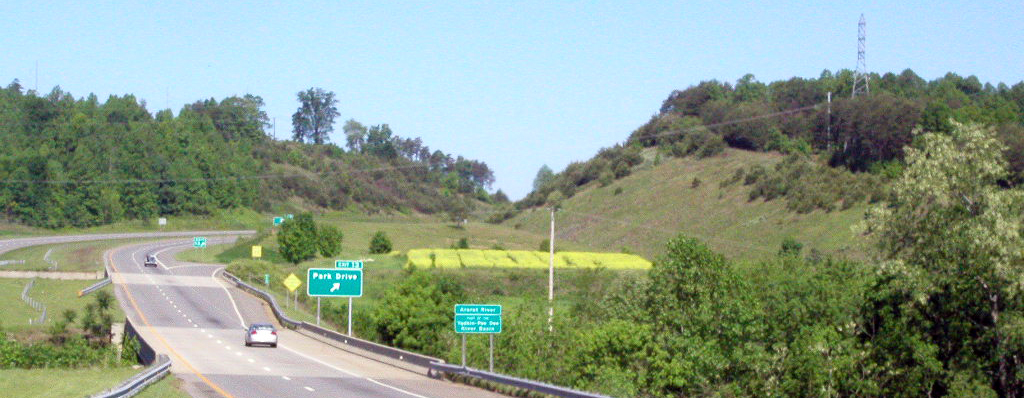
Biofuel crops on a roadside near Raleigh. Photo: NCDOT
Scientifica Gets Durham School Kids Excited about Science
Monday, August 16, 2010, 7:25 am 1 Comment | Post a Comment
Dr. Anu Sud talks to Robby Fisher, a Durham student participating in the Scientifica program she helped found.
Dr. Anu Sud’s two daughters were accomplished in science by the time they were in high school, in part thanks to coaching by their mother, who had been a cytogeneticist at UNC-Chapel Hill and at LabCorps. The older daughter attended the North Carolina School of Science and Mathematics, and the younger, Shivani, won a $100,000 scholarship in the Intel Science Talent Search and numerous other top science honors when she was a junior and senior at Jordan High School.
When Shivani went off to Princeton, Dr. Sud was like many professional women who interrupt their careers to raise kids: should she return to her former career or try a new path? Then Shivani said to her, “Mom, why not help other kids like you helped us?” Read more…
Lyme disease, ecologists, and public health
Friday, June 25, 2010, 9:10 am 2 Comments | Post a CommentLast week I wrote about the impacts of swine operations on our water quality. It’s one example of how land use patterns can disrupt the environment and affect public health. That subject came up again this week during a conversation with Dr. Laura Jackson of the Environmental Protection Agency’s National Health and Environmental Effects Research Laboratory (NHEERL), a unit of the EPA’s Office of Research and Development that is housed in Research Triangle Park.

Dr. Laura Jackson of the EPA's National Health and Environmental Effects Research Laboratory (NHEERL), a unit of the EPA’s Office of Research and Development that is housed in Research Triangle Park.
Dr. Jackson and her colleagues in this RTP lab—more than 100 scientists—conduct research on ecosystem services, those benefits provided by the environment over and above the psychological benefits of being out in nature. These services can have tangible and measurable economic value.
For instance, in a normally functioning ecosystem, vegetation would take up nitrogen and phosphorus from animal waste and keep those nutrients from overburdening groundwater and streams. In last week’s example, when hogs were added to an ecosystem, they knocked it out of balance by depositing more nutrients than the vegetation could handle and by removing plants that could take up the nutrients and provide erosion control. The researchers at the Center for Environmental Farming Systems were developing countermeasures to keep the water clean near hog farming operations and restore ecosystem function. Read more…
Is your barbecue causing water pollution?
Monday, June 14, 2010, 6:49 pm 2 Comments | Post a CommentFarmers’ market managers tell me that consumers are becoming incredibly knowledgeable, quizzing farmers about their use of chemicals and antibiotics in order to be well informed about the food they eat. Now here’s a new question to ask farmers when you buy pork: what are you doing to protect the environment?
Here’s the background. Hog production is one of the cornerstones of North Carolina’s agricultural economy, with more than 10 million hogs produced annually in the state, or roughly one pig per person. In recent years, most of these hogs have been raised in indoor operations known as Concentrated Animal Feeding Operations, or CAFOs.
But consumer demand is driving a movement back to pasture-raised pork, and about 100 farmers in the state are responding to the call for hogs raised in natural conditions that many people consider more humane.
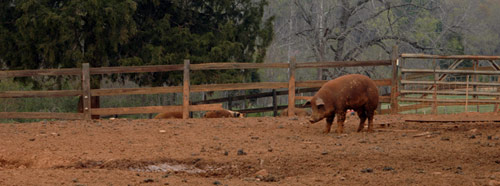
Consumers are driving the market for pasture-raised pork. Photo by Lisa M. Dellwo
Seventeen Years of Discovery in Duke Forest
Tuesday, June 1, 2010, 1:22 pm 5 Comments | Post a Comment
Higher concentrations of carbon dioxide are pumped into four of the experimental rings. Photo: Will Owen
Late in 2010, an epic ecological experiment in the Triangle will begin drawing to a close when carbon dioxide stops pumping from four massive rings of towers in the Duke Forest. Since 1996, more than 250 scientists at Duke and dozens of other institutions have measured the response of this forest ecosystem to the elevated amounts of carbon dioxide expected in the Earth’s atmosphere in the future. They’ve measured tree and plant growth, photosynthesis, leaf size, soil composition, root growth, and water use in the plots bathed in elevated carbon dioxide and in three other “ambient” control plots.
The first, prototype ring was built in 1994; six more came in 1996 (three controls and three experiments). Each ring consists of 16 metal towers in a 30-meter diameter. Computer-controlled instruments in the experimental rings bathe the interior of the plot in carbon dioxide. It’s called Free-Air CO2 Enrichment, or FACE. As opposed to “chamber studies,” in which plants are studied in carefully controlled growth chambers or greenhouses, the rings are open to nature. That means that mammals and insects can circulate freely and that natural events like hurricanes, ice storms, and droughts affect the research site. Read more…


