
Humans, monkeys age the same, say Duke primatologists
Sunday, March 27, 2011, 7:13 pm No Comments | Post a CommentOriginally published: 3/17/11
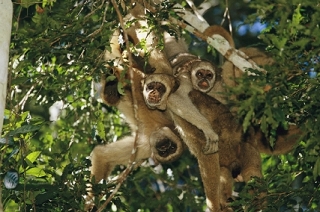
Studies find the muriqui monkey can live as long as the average human being
Humans share 98 percent of their DNA with monkeys. Clearly, the two species have a few things in common. One, say researchers from Duke University, is how we age.
Dr. Susan Alberts, a Duke biology professor, has been studying baboons in Kenya’s Amboseli National Park for quite some time. In fact, she’d just gotten off a flight home, she mentioned when interviewed.

Dr. Susan Alberts
Alberts is one of several Duke scientists who have teamed up with universities across the world to study aging behavior in wild primates. She said data was combined from seven different studies on non-human primates, each spanning 25 to 50 years. Two of these—the Jane Goodall Institute study on chimpanzees and Alberts’s Amboseli study on baboons—were based at Duke.
Findings from the studies appear in the March 11 edition of Science.
The studies chronicle primates over the course of their lives. Monkey populations were observed for births, deaths and physical deterioration. Alberts said long-term primate studies like these are invaluable to putting the human experience in perspective.
“Before, we didn’t have anything to compare to that was like us,” Alberts said. “So we were comparing ourselves to lab mice. And we are really different than lab mice.”
Dr. William Morris, a Duke ecology and population biology professor who assisted Alberts, said main conclusion of the report was that aging patterns and mortality risks coincide between humans and non-human primates.

Dr. William Morris
“Your chance of dying increases with age in a similar way whether you’re a gorilla or a baboon or a human,” said Morris. “Humans still win, but we’re not too far away from our primate relatives.”
According to the report, female chimpanzees often live into their forties, some even into their fifties. Males live into their thirties but are mostly dead by their early forties. Morris said the monkey with the longest life expectancy was not the chimp or gorilla, but rather the lesser-known Brazilian muriqui, which can survive all the way into its seventies.
That is not too far off from the average life expectancy of a human, said Dr. Anne Pusey, chair of Duke’s evolutionary anthropology department. Nowadays, the typical American male will live into his eighties. Females, she said, live slightly longer. The gender difference is more pronounced in monkeys, though, because of male-male competition for reproductive opportunities with a limited number of females.
Pusey has been working with renowned British primatologist Jane Goodall at her chimpanzee park in Tanzania since 1970. In the wealth of data she’s collected over four decades, she has developed an eye for identifying chimp aging behavior.

Dr. Anne Pusey
“Just knowing more about mortality patterns in other species helps us think about the evolution of our mortality patterns and understand which patterns are fixed and which are more elastic,” Pusey said. In the future, she and her colleagues plan to investigate how reproductive rates change with age.
“Humans are unusual in this regard because we hit menopause and continue to live a long time afterwards,” she said. “But female chimps go on having babies up until they die.”
Pusey took on her job at Duke last year. She said she was attracted to the area because she feels it’s one of the best of its kind in the country. Also, she had heard about Dr. Alberts’ study and discovered how much potential there is for primate research in the Triangle region.
Alberts said she’s interested in how animals use social behavior to solve environmental problems and how that impacts their survival. What characterizes the human race, she said, is that we’re primarily monogamous, which levels out competition among males.
This might seem counterintuitive at first. If females only mate with one male, wouldn’t there be increased drive for men to settle down with the most desirable female? Alberts said it is actually a great equalizer for the men, and everyone still ends up with a partner.
However, in non-human primate species, not everyone does. The females mate with multiple fathers, but not every male passes that litmus test.
“If females only mate with one male, it isn’t how many kids he’s going to have but how good a mate he’s going to get,” she said. “In primates, the least successful male wouldn’t have any kids at all.”
One finding that surprised her was that primate males are able to differentiate their own offspring. She found this remarkable since females mate with many different males in the course of a lifetime and there’s no discernable way for fathers to keep track of who’s whose. Paternal care goes very deep in our primate roots, she said.
“Human males are very good fathers, especially compared to most mammals,” said Alberts.
So in a lot of ways, socialization has factored into reproduction and life expectancy. Insight like this, Morris said, paves the way to understanding how human evolution has digressed from that our hairy ancestors.
“We live longer than the other primates because of the environment we create for ourselves,” he said. “Nutrition, modern medicine, health care—other primates don’t have these things.”
To Morris, the importance of the Amboseli study is in advocating long-term primate research because he thinks that’s how we really learn about the aging process. He said it’s much different than the plants he studies.
“With trees you can take a look at the core and see how old it is,” Morris said.
“You can’t do that with baboons and monkeys. You really need to follow them around to get the whole picture.”


