Posts Tagged ‘Chapel Hill’

POZEN’ a threat to outdated pharma marketing
Thursday, May 26, 2011, 3:42 pm No Comments | Post a CommentOriginally published on TheRTP Blog, 5/25/11. Watch The RTP’s exclusive sit-down interview with Liz!
For 25 years, Liz Cermak worked for Johnson & Johnson, one the biggest names in the pharmaceutical business. Now, she works for one of the smallest. And she says in terms of marketing, it’s giving the Goliaths a run for their money.

Cermak is the executive vice president of POZEN, Inc., a Chapel Hill-based pharma developer/manufacturer with no more than 30 employees. Since coming onboard in 2009, she has overseen the company attain FDA approval on two authentic combination drugs: Treximet and VIMOVO—for migraines and osteoarthritis, respectively. No small feat, even by J&J standards.
But what Cermak is most excited about is POZEN’s fresh and unique approach to pharmaceutical marketing.
Instead of sending sales representatives to hospitals and doctors’ offices to promote their products, Cermak and her team pitch most their medicines online.
“The reality is that the current sales rep model of traditional pharma is obsolete,” Cermak said to a packed house at the Marketing Mondays series held at The Research Triangle Park HQ earlier this week. “Eighty-six percent of US doctors go online for product info now, and 82 percent are on smart phones.”
In-person sales pitching can be inefficient, she said, because all health care workers are overbooked and overbusy, and representatives must endure a costly wait just to get two minutes in with the doctor.
Two minutes. That’s the average rep-doc face time. But online, the average time spent by a physician on a single ePromotion activity is eighteen minutes.
Cermak has three rules for digital pharma marketing:
1. Develop products that deliver real value to customers.
Be relevant and learn from your customers. Understand their needs and study their e-behavior. Most pharmaceutical companies need to broaden their apertures here, she said.
2. Make them affordable and accessible.
POZEN recognizes the strains today’s pharmaceutical pricing puts on doctors and patients today alike. As should go without saying, costs must be kept low to compete and to demonstrate a respect for your consumers.
3. Engage with customers in a meaningful but highly efficient way.
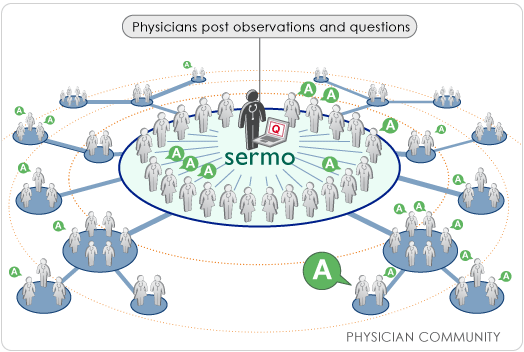
This means using social media and online public networks like Facebook and LinkedIn, but also more exclusive, MD-only communities like Sermo or CogNet. Use push and pull marketing tactics; see what works and what doesn’t.
Cermak calls this “Pharma 3.0”.
“The change isn’t coming,” she said. “It’s here.”
We’ve seen this before with other industries, as well. Amazon now sells more books for the Kindle than it does in print, and Netflix’s superior, customer-based business model has Blockbusters closing up shop around the country. The global economy is now decidedly digitalized and will only continue to shift that way.

Now, as POZEN enters the final testing and approval phase for its latest development, an ulcer-reducing aspirin compound dubbed PA32540, a viral campaign is already underway to spread the word.
Cermak stressed there is still utility in face-to-face interaction, though. Sending sales reps is important to explaining drug principles to doctors, learning about clinic demographics, and building a personal rapport with primary care physicians. However, there are not enough reps to go around as it is now, and focusing sales online will drastically cut down their jampacked schedules.
The biggest advice Cermak has for pharma companies looking to try this new approach is to not be afraid to experiment. To take risks. And to lose.
“Be ready to try and fail,” she said. “Absolute ROI of a given digital initiative cannot be accomplished with a high degree of certainty.”
No one expected it to work out for POZEN. But no one expected 30 people from Chapel Hill to get two drugs FDA-approved in two years, either.

Conference Sheds Light on Rare Disease with Links to Autism
Monday, June 21, 2010, 12:19 pm 2 Comments | Post a CommentAny time you learn something new, your brain undergoes a sort of remodeling to store the fresh bits of information. This process takes advantage of what most brain scientists refer to as “neural plasticity,” the ability of our brains’ synapses – the connections from one neuron to another – to strengthen or weaken in order to house new memories.
For most of us, our neurons remain malleable throughout our lives, giving us the opportunity for lifelong learning (though it does get harder with age). But for those afflicted with the rare genetic disease Angelman syndrome, the synapses are almost completely incapable of being remodeled. By the time children with Angelman syndrome are toddlers, their synapses have largely lost their plasticity, hardening like concrete into rigid structures that can no longer easily relay new information.
The result is quite tragic – children whose bodies grow and age normally but whose brains are locked forever in the state of a two year old. But there is also reason to hope, as tremendous progress has been made in the understanding of Angelman syndrome, say many of the researchers, clinicians, and parents in attendance at a recent conference on the disorder. The 2010 Angelman Treatment and Research Institute Scientific Symposium, held at the Carolina Inn in Chapel Hill on June 15 and 16, showcased the current research on the genetic disease, with efforts tapping into the latest technological tools from mouse models, brain imaging, stem cells, proteomics and gene therapy.
“Over the span of the conferences I have attended, I really feel like I can see the gap getting smaller between the cellular molecular finding and its clinical applications,” said Heather Adams, a neuropsychologist from Massachusetts who specializes in kids with cognitive impairment. She also has a daughter with Angelman syndrome.
Angelman syndrome is a rare intellectual disorder that affects about one out of every 15,000 people. It is often placed on the autism spectrum because of the shared language difficulties and inappropriate social behavior. The language impairment in people with Angelman syndrome is much more severe than in those with autism – in fact, most of them never speak a single word. And whereas individuals with autism might shun social interaction, those with Angelman are quite social.
“One of the very endearing things about these individuals is they have a very happy demeanor,” said one of the conference’s organizers, Ben Philpot, an Associate Professor in Cell and Molecular Physiology at the University of North Carolina. “They are often said to have inappropriate laughter, but I think that they just find more things in life funny than we do.”
Their child-like view of the world – and the detrimental ramifications of a brain that is unable to change — all stem from a defect in a single gene called UBE3A. If the gene is mutated or deleted, the result is Angelman syndrome. But if it is duplicated, it may result in one of the more classic forms of autism. And altering its function can also lead to tumors of the cervix, though in the cancer field the gene goes by the name E6AP. So studying this one gene and its effects on the plasticity of our brains could have far-reaching implications.
“The work related to synaptic plasticity in genetic syndromes is forming thrilling insights as far as how we reason and learn things,” said conference attendee William Snider, director of the UNC Neuroscience Center.
At the two-day conference, scientists from across the country presented their latest findings on the role of this infamous gene in disease. One of the invited speakers, Harvard’s Michael Greenberg, explained the findings he had recently published in the journal Cell on targets of UBE3A. The molecule’s main job is to mark other proteins to be broken down or destroyed, so if UBE3A is absent then certain proteins accumulate to inappropriately high levels, causing subtle but lasting damage to our brain cells.
“If we know what the targets are we may be able to produce therapies that can break them down when UBE3A is no longer able to do its job,” said Philpot.
Philpot’s own work has indicated that pharmacotherapeutics or behavioral modifications may be able to restore the brain’s plasticity. He is currently using funding from the NC Translational and Clinical Sciences Institute (NC TraCS) to search for new molecules to treat Angelman syndrome, an area that is understandably of intense interest for many in the field.
“As a scientist I say the progress that has been made so far is remarkable, but as a parent, I say it is not fast enough,” said Alina Szmant, a marine biologist from Wilmington who has a 31-year-old daughter, Selena, with Angelman Syndrome.
Mark Nespeca, a clinician at Children’s Hospital in San Diego who also attended the conference, says that the pace of research depends a lot on your perspective. Because he does not conduct research himself, conferences like this one help him keep up with the many advances that have occurred since he was in medical school.
“With the advances in technology today, people are talking about sequencing your entire genome for just a thousand dollars,” said Nespeca. “There may come a day when kids will be coming to us at two months of age newly diagnosed, and we can say is there something we can do to make a difference so you can walk, can talk, not have seizures. But for a parent dealing with this illness day in and day out, it must be hard to wait and hope for that day to come.”


