
Is your barbecue causing water pollution?
Monday, June 14, 2010, 6:49 pm 2 Comments | Post a CommentFarmers’ market managers tell me that consumers are becoming incredibly knowledgeable, quizzing farmers about their use of chemicals and antibiotics in order to be well informed about the food they eat. Now here’s a new question to ask farmers when you buy pork: what are you doing to protect the environment?
Here’s the background. Hog production is one of the cornerstones of North Carolina’s agricultural economy, with more than 10 million hogs produced annually in the state, or roughly one pig per person. In recent years, most of these hogs have been raised in indoor operations known as Concentrated Animal Feeding Operations, or CAFOs.
But consumer demand is driving a movement back to pasture-raised pork, and about 100 farmers in the state are responding to the call for hogs raised in natural conditions that many people consider more humane.
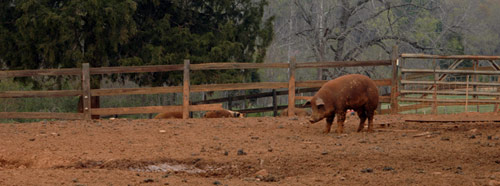
Consumers are driving the market for pasture-raised pork. Photo by Lisa M. Dellwo
There’s no doubt hogs raised outdoors are happy, says Silvana Pietrosemoli-Castagni, research associate at the Center for Environmental Farming Systems’ (CEFS) Alternative Swine Production unit. “Outdoor pigs can express their natural behavior,” including foraging, exploring, wallowing, roaming, and rooting, she says, resulting in less stress and therefore stronger immune systems. “Pigs are social animals and in these kinds of systems, they can interact and establish social relationships,” she says.
Silvana Pietrosemoli-Castagni researches ways of mitigating the environmental impact of raising hogs outdoors. Photo by Jennifer Curtis
Raising pigs in pastures also avoids some of the environmental hazards that indoor facilities are notorious for—noxious odors, air pollution, and risks of spills from waste lagoons.
But those happy hogs have the potential to damage the environment, too. The biggest danger is that nutrients from hog waste will reach waterways, causing water quality problems and changing aquatic habitats. This can happen when excessive nutrients like phosphorus and nitrogen leach through the soil into the ground water or when the hogs’ natural rooting behavior causes erosion.
According to Jennifer Curtis, who heads NC Choices, a CEFS initiative that promotes sustainable food systems, there is no legal definition of “pasture,” and consumers might be shocked to see the moonscape left behind when mature hogs are removed from a field. Hogs will dig up plants by their roots, while grazing cows would merely mow them.
So how can farmers respond to consumers’ demand for hogs raised humanely while still protecting the environment and remaining profitable? Responding to requests from farmers for better management practices, Pietrosemoli-Castagni and her colleagues are exploring several alternatives:
- reducing stocking density, or the number of pigs raised in a particular paddock.
- using pigs as part of a rotation system in which crops are grown on fields formerly occupied by hogs, to trap and utilize the nutrients in the soil.
- creating buffers between hogs and waterways to protect against runoff.
- moving water and food stations to reduce soil compaction and distribute nutrients from hog waste more evenly.

With their natural rooting behavior, hogs will eventually denude a pasture. Photo by Jennifer Curtis
Rotating hogs with crops helps freshen pastures, keeping hog waste from waterways. Photo by Jennifer Curtis
The research is being conducted at CEFS’s 2000-acre Cherry Research Farm facility near Goldsboro. The farm and CEFS are jointly operated by N.C. State University, N.C. A&T University, and the N.C. Department of Agriculture and Consumer Services. CEFS researchers include soil scientists and veterinarians as well as agricultural specialists studying organic cropping, best practices for small farms, pasture-based dairy farming, and even alternative energy sources for farmers.
The swine unit has been operating since 2004 and also conducts research on raising pigs in hoop houses, a common practice in Europe and in Iowa, the largest hog-producing state. In addition to research, they provide extension services, educating farmers on the best practices they’ve discovered.
So the next time you buy pork, ask your farmer: what steps are you taking to be a good steward of the land?


Most folks are not aware that there is a breed of swine known for its tendency NOT to root being extremely easy on pastures and fencing. It is also generally agreed that they do well on pasture alone not needing additional feed for good condition. The KuneKune Pig breed cannot compare to its commercial cousins in size or leanness, but it has some characteristics that would be very beneficial to the outdoor hog producer.
Thanks for this information, Lori. -LD